In September 1995, 30,000 activists and 17,000 participants streamed into Beijing for the opening of the Fourth World Conference on Women. For the next two weeks, representatives of 189 countries discussed and developed historic commitments on gender equality and women’s empowerment around the globe. The final product of the conference was the Beijing Declaration and Platform for Action. It was a blueprint for advancing women’s rights and it set forth thorough commitments under twelve key areas of concern, including women’s health, education, violence against women, and women in the economy.
Unfortunately, over 25 years later, no nation has achieved gender equality in all dimensions of life, as originally envisioned by the Beijing Declaration. Nearly one third of all women suffer from physical or sexual violence in their lifetimes. Without adequate healthcare, nearly 800 women die giving childbirth every day. Over 80 million women globally have no legal protection against discrimination in the workplace. Not a single country is on track to achieve gender equality by the year 2030. But it seems we hear statistics like these all the time. Why, then, does gender equality remain an unattainable target?
Dear Readers: As I was writing this blog post, it started to sound more like a poem than an article – so I turned it into one. The above audio contains an introductory note to the piece as well as a voice reading of the poem so that you can listen along as you read.
“Sometimes I wonder if the Asian American experience is what it’s like when you’re thinking about everyone else, but no one is thinking about you.”
-Steven Yeun
Let’s talk about this past week and the hate crimes perpetrated against Asian Americans the last few days in Oakland Let’s talk about this past year and our past period in American history This neglected narrative This invisible experience
While the country does its annual round of capitalizing off of Lunar New Year this weekend, I think about the Asian Americans who will spend what is supposed to be one of the most festive and important holidays in their culture cowering instead of celebrating Let me tell you about the attacks that have been happening because you won’t find them headlining on national news A conversation that is long overdue
An 84 year old Thai man was attacked in bright daylight and died from his injuries Vicha Ratanapakdee Say his name and pronounce all. of. it.
Numerous robberies and assaults in Oakland’s Chinatown A 91 year old man was pushed down It was like watching my own grandfather get slammed into the pavement Look up the video on your own if you want to see it but I refuse to circulate Trauma Porn – my trauma, your porn Non-POC: You cannot fathom how personally traumatizing it is to watch these videos
Faces slashed, grandmothers set on fire The sheer volume of violence is staggering I’m having a hard time grappling with this inhumanity against our elderly Our elders Who are revered and respected in our culture in a way unlike the culture of this country Who rose from the ruins of a broken nation seeking solace Searching for a better life in the Land of Opportunity that only knew them by the word Foreigner
In the wake of these assaults there is one word that comes to mind A word that has been grinded and conditioned into the Asian American experience: Invisible Anti-Asian sentiment since the beginning of this pandemic Targeted hate crimes have surged by almost two thousand percent
Where are you, CNN? Where are you, my fellow activists and leaders of social justice? Deafening silence from the news media and our so-called allies Feigned outrage only when it’s trendy I am traumatized by your apathy
You cannot be anti-racist without acknowledging the Asian American experience.
Enough with the narrative of the Model Minority What is the Model Minority Myth? I guess I’ll save you the self-education And tell you about a nation that only respects you when you keep your head down and talk nice Get good grades and that’s the price of being tolerated in White America But despite staying out of trouble and being quiet equality never comes with being compliant
Because you see, the Model Minority Myth was weaponized by our government back during the Civil Rights movement to say that there is a “correct” way to be a minority The audacity of White Supremacy To give us a pat on the head for being silent To take a diverse race of people and reduce them to a monolith The audacity of White Supremacy To use us as their tools to undermine the Black fight for civil rights To pit minority groups against each other and further the divide
A nation built on the backs of Black people and immigrants Born with this burden that we were doomed to carry as soon as our lungs drew in the first breath The breath that got heavier and heavier with each year of life A life of N*****, Ch*nk, Oriental, “blacks” as a noun with a lower-case B, Dred Scott, Korematsu, Plessy Yellow Peril, Chinese Excluded, For Colored Only A life of imperialism and colonization and cultural appropriation A life of “I think you may have confused me with the other [insert indistinguishable face of color] in this room” and “I’ve never dated a [insert fetishizable object of color] person before” and “But what’s your real name” and “Can I touch your braids” and “Your English is good” and “You don’t sound Black” and “Your lunch smells funny” and “Go back to your country”
No amount of the Model Minority Myth embedded in deep interracial conflict will change the fact that we have always been seen and treated as secondary citizens If citizens at all
From a young age I didn’t know how to take up space It’s having to laugh off microaggressions because we are made to feel that the racism against us isn’t real – is miniscule, is just a joke Gaslit over and over We are told to embrace our “good stereotypes” I mean what exactly is our plight when we’re all just so good at math Right? But this Myth invalidates the reality of the Asian American experience Our internalized racism, our intergenerational traumas Our women the subject of hyper-sexualization Our men the epitome of emasculation It paints us as submissive and void of personality Strips us of our individuality It erases the millions of low income Asian Americans that exist in poverty It ignores the historic underfunding of Chinatowns as people huddle around what little reminders they have of their homeland It silences our struggles and shoves them to the sidelines This repulsive notion of white proximity
I’m tired of being told that we are not Oppressed Enough. Enough.
We are not your model minority.
I’ve said this a hundred times and I’ll say it again: The burden should not fall on people of color to be educators I’m going to be honest and I hope you will be modest enough to listen Because writing this piece was so exhausting So emotionally draining I wanted to swallow my words, swallow my pain To shut off my brain and just mourn in bed I wished I was privileged enough to write about Snow Day instead But instead I opened a Google Doc and my curtains and my wounds
This toxic rhetoric of “Your oppression isn’t as bad as mine” and “Now is not the time” Sorry but I didn’t know that racism had a sign-up sheet A hate crime against one community is a hate crime against all of our communities We all suffer under the puppetting hand of this systemic oppression The problem is not us and each other and this underlying tension The problem is White Supremacy so pay attention
If your anti-racism isn’t intersectional, are you really anti-racist? Don’t ask us to shrink our space when we have already gone our whole lives feeling small I promise that there is enough space to go around this arena of Oppression Olympics that was designed to be the modern day Hunger Games Designed to point fingers and call names but we are all pawns of the same system So shouldn’t we be asking instead: who designed it? And how do we get out? Unity is not possible with White Supremacy But unity against it is necessary to defeat it The only way out is together Diversify your narratives so we can do and be better So that we can uplift all of our communities and stand in solidarity This struggle for safety This struggle for scraps of space at each other’s expense
But now that I’m here, let me make this clear: Asian Americans cannot find safety in the same institutions that terrorize Black Americans Although we are wounded, the police must still be defunded Increased policing is not the answer Black Lives Matter So we must make good on our promise from last summer To use our privilege and protect the Black community So instead of calling for increased policing that will harm Black bodies Let’s get to the root and provide adequate services and resources for all of our communities Let’s rid this false notion that there is mutual exclusivity in this fight for equality The solution lies in addressing this violence that is rooted in White Supremacy A violence that is not the violence that we see but the violence that is Unemployment, Homelessness, Wealth Hoarding, Redlining, and Poverty
So let’s turn this mentality into a new story One where Asian Americans can take up space unapologetically and speak their truths and shed their invisibility One where our white and POC allies support us openly by condemning anti-Asian violence in their own communities I challenge you to check your own biases and follow through on your commitment to diversity See us, show up for us, and take on responsibility Hold accountability
Marginalized freedoms have always been and will always be intertwined My pain is your pain is our collective pain It is our collective grief and our collective loss And so your fight is my fight and my fight Should be yours, too
Rosa Kim is a second-year student at BC Law. You can reach her at kimeot@bc.edu.
Yesterday was nothing short of horrifying, but unfortunately, I can’t say that I’m surprised. This act of domestic terrorism was not unexpected. It was the result of one of the most divisive American presidencies of all time; it was but a likely consequence after months of repeated baseless allegations of election fraud.
That is why I am sick of the “this is not our America” rhetoric. Because this is exactly our America right now, and we best believe it. The “this isn’t our America” rhetoric lets us think that what happened yesterday was unpredictable. It allows us to neglect that the riots stemmed from a system historically built upon and contemporarily sustained by white supremacy. If we begin to believe what happened yesterday was an anomaly, it lets us shirk away from accepting that the root of the problem is deeper than the current presidency: it is an entire system that is in dire need of reform.
Screenshot of performer, author, and storyteller, Joel Leon’s Tweet/Instagram post.
I am pleased to announce the launch of Boston College Law School’s podcast Just Law.
I am 1L Tom Blakely and will be hosting the show alongside 3Ls Lea Silverman and Kevin O’Sullivan, and fellow 1L and Section 3er (the best section) Joanna Plaisir.
We are very much appreciative of our tremendously talented editor and producer 3L Mark Grayson, and the institutional support from Boston College, specifically Director of Marketing and Communications Nate Kenyon.
Note: Identifying information has been changed to protect the privacy of those mentioned.
There come few more humbling experiences in life than getting destroyed at a video game by an 8 year old. In my heyday, I knew my way around a PlayStation controller. But times have changed.
I was sitting in a room on 10 NW, the ward of Boston Children’s Hospital reserved for surgery and orthopedic patients.
It was my first night as a volunteer at the hospital.
There are many reasons one gets involved in community service. For many, school and work requirements, as well as retreats and other social events will often prescribe the rolling up of one’s sleeves and getting out there. Many people also enjoy the intrinsic reward and benefit of making a positive difference in the world around them.
Today I am hosting a guest blog by Phil Privitera ‘95. You can reach him through the bclawimpact@bc.edu email.
At a recent Somerville Redevelopment Hearing — with only selected information in front of them and public input filtered through administrators promoting the public project — an all-white Somerville Redevelopment Board voted in favor of a plan to take and relocate minority immigrant businesses, as well as residential tenants, in order to make a vacant parcel behind them more attractive for a yet-to-be-named, possible developer in the future.
While attending University of Chicago in 2018, I had the good fortune to have a part-time job as a community outreach coordinator for the soon-to-be-released “RBG” documentary. On premiere night at the Chicago Gold Coast theater the Chicagoans I had come to know turned out in force. The gray-haired justice book group was followed by some little girls with their mothers. Film buffs, law students, elected officials, and a church group were all present and excited to learn more about this notorious intellectual giant. Everyone was moved by her story. The little girl who went in wearing an RBG costume came out standing a little taller in her black robe and jabot. This was the power of her transcendent appeal.
About five years ago, I stumbled onto some Afrofuturist art in a market in northern Uganda. I was moving through a maze of kitenge stalls when I came to a makeshift gallery that a young artist had set up in a forgotten corner of the market. One of his pieces was of a dramatic skyline, with arched spires climbing into the sky, draped in tropical vegetation. In the foreground, people in stylized, angular kitenge clothes were walking through a bustling public square. I asked him what it was and he said, “It’s the Kampala of the future.”
In contrast to a lot of antiseptic and tech-centric futurism, his mix of sci-fi architecture, verdant ecology, traditional culture, and civic harmony suggested that the ideal future would incorporate a healthy dose of the past. It reminded me of an aphorism from the other side of the African continent, embodied in the adinkra symbol, Sankofa, which depicts a bird with its head turned backward, retrieving an egg. The Sankofa symbol and word convey the idea that in moving forward, it is important to bring along what is essential from the past.
Today I am hosting a guest blog from alumnus Michael B. Goldenkranz ‘78.
Part of what drew this Jewish boy from Brooklyn to BC Law in the mid 70’s was prior Dean Robert Drinan S.J., who left to become a U.S. Congressman shortly before I began law school. Both his and the School’s continuing and unwavering commitment to human rights and social justice, and the mission to “prepare students to not only be good lawyers but lead good lives,” still resonates with me today.
I have tried to instill those values in my now grown children, and to remind them to always question assumptions, as I remember doing during my time at BC Law. My son David, a former primary/secondary school teacher who has also worked on documentary filmmaking, is taking the opportunity to use today’s calls for racial justice and equality to examine his status as a privileged white male in ways that may be sometimes viscerally painful, but certainly necessary. His recent essays include “Pajamas are a Privilege,” “White American PTSD,” “A Black and White Matter,” “What Kind of a Dog are You?” and “Colorblindness: The Façade of Equality.”
Like the cases we studied at BC Law and the discussions we had in our classes, I find David’s writings thoughtful and provocative. They make me think about uncomfortable but really important issues in ways that I think would please Fr. Drinan. My hope is that we may continue to strive to lead good lives and fight for social justice and equality for all.
Guest blogger Rita Muse ’15 comes from a line of BC Law graduates. Her grandmother, Judge Mary Beatty Muse, graduated in 1950, her aunt, Patricia Muse, in 1990, and her cousin, Julie Muse-Fisher, in 2005. Her uncle, Christopher Muse, though not a BC Law grad, has been a longtime adjunct professor at the Law School. He and Rita’s grandfather, Robert Muse were instrumental in the release of the wrongly convicted Bobby Joe Leaster. Their engagement with Leaster in the 1980s had a lasting impact on the Muse family, including on Rita, who, as a law student, helped to free another innocent man.
Bobby Joe Leaster: A Remembrance
By Rita Miuse ’15
When Bobby Joe Leasterspoke to BC Law students and faculties, his story was the same but his message never got old; he was wrongfully convicted of murder and unjustly imprisoned for almost 16 years, but he dealt with injustice in his own profoundly special way. This past April 26, one of BC Law’s favorite guests and a beloved citizen of Boston, passed away from the severe burns he suffered in a home fire three weeks earlier.
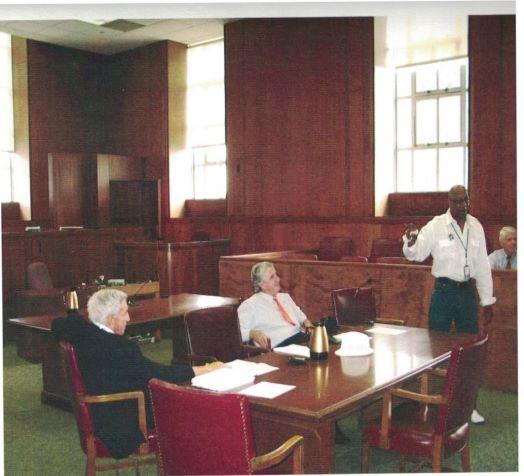
Bobby Joe Leaster, with his lawyers, Robert and Christopher Muse, teaching Judicial Youth Corps students in the courthouse where he was convicted.
This is my remembrance of the person who motivated me as a student, inspired me as a lawyer, and became a friend of my family, two of whom, my grandfather Robert Muse and my uncle Christopher Muse, a longtime adjunct professor at BC Law, helped to free Bobby Joe.


 BC Law: Impact