A Seed of Passion, Planted in Law School

Many of us have probably read a number of articles or heard various talks on immigration issues. However, it’s not every day that we hear from the man who oversees our nation’s immigration procedures and policies.

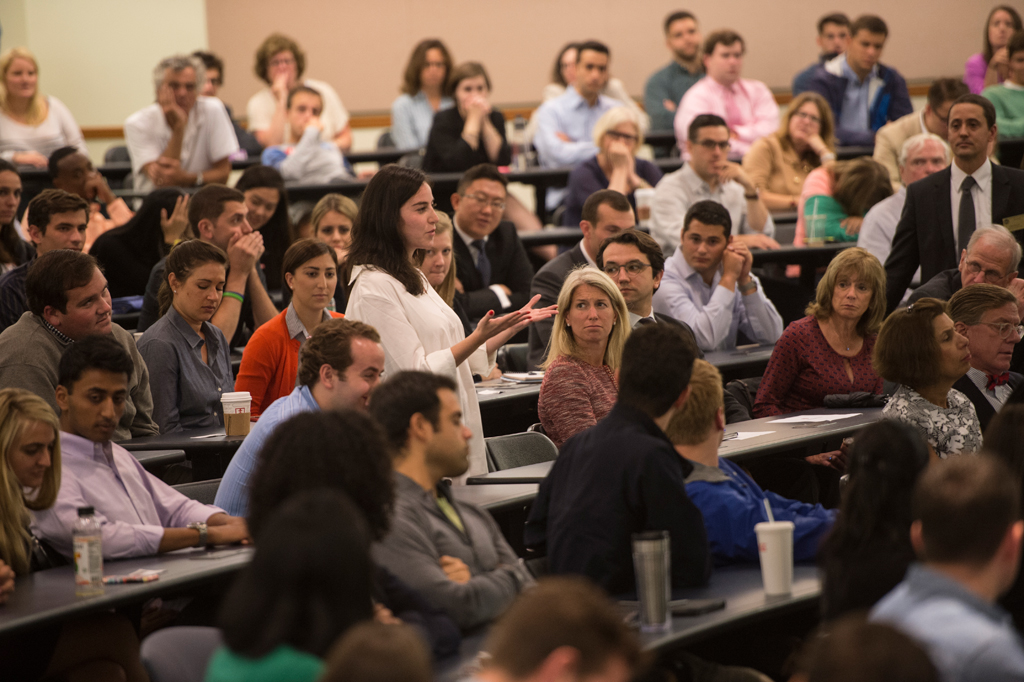
Two weeks ago, the director of the U.S. Citizen and Immigration Services (USCIS), Leon Rodriguez, came to BC Law to deliver the annual Owen M. Kupferschmid Holocaust/ Human Rights Project (HHRP) lecture. Rodriguez is a BC Law alum (Class of ‘88) and was involved in the HHRP himself when he was a student. Rodriguez attributed his passion for immigration work to his experiences at BC Law. He was particularly inspired by the HHRP and by fellow classmates who were passionate about human rights. Rodriguez has since dedicated his entire career to public service, working in various capacities such as assistant district attorney and assistant attorney general before joining the USCIS. His story is a reminder that our current law school experiences and relationships play a significant role in shaping our future career paths.

Continue reading →

The Conservative Legal Movement and the Importance of Intellectual Diversity in Law

“I have never known any distress that an hour’s reading did not relieve.”

-Charles de Montesquieu

I’m James Barasch, a 1L and I’m pleased to be joining Impact! I used to run a book review column and blog during my time at Tufts University, and I thought I’d continue that tradition here at BC Law.

Over Winter Break, in between holiday celebrations and summer job ponderings, I relaxed by reading “The Rise of the Conservative Legal Movement: The Battle for Control of the Law” by Steven M. Teles. Starting in the 1970s, Conservatives sought to reverse the growth of legal liberalism by focusing on creating their own corps of professionals in law schools, public interest groups, and in the judiciary. Teles relates the story of political experimentation and individual innovators who organized and led this countermovement to significant successes and the prominent place many of its organizations, such as the Federalist Society, the Center for Individual Rights, and the Institute for Justice now hold in modern American legal culture.

Continue reading →

A Mutual Respect: The Glue that Binds Us

Hello everyone! This week, I’m hosting a guest blog from Margie Palladino ’85, the outgoing Alumni Board Chair for Reunions. I’m thrilled that she’s agreed to write about her BC Law experience for Impact.

Margie was the recipient of the Boston College Law School’s Outstanding Reunion Volunteer Award for generating record attendance for her class’s 25th reunion. Margie is principal of Reunions Reinvented LLC, a business that generates momentum for professional school reunions. She is a former partner at the Boston law firm of Sherburne, Powers and Needham, now known as Holland and Knight. 

Nearly 600 people came together in November to celebrate the BC Law School reunions. It was wonderful to witness so many alumni—young and old—reconnecting with classmates and professors and rekindling memories of their law school days. There were BC Law alumni from all walks of life: the judiciary, private firms, corporations, public service, academia, and government (including a state governor, US senator, and several congressional representatives). Equally impressive was the number of alumni present who had stepped out of the legal profession temporarily or permanently to take care of their families or pursue entrepreneurial, volunteer, and other valued interests.

Continue reading →

Why You Should Consider Corporate Restructuring/Bankruptcy Law

BC Law offers many opportunities for students interested in working at large law firms, typically placing approximately 30% of the class in firms of 100 attorneys or more. For students who want to work at large firms (many do not), there is a common question that students hear from fellow students, attorney-friends, and most importantly, law firm interviewers: “Are you interested in corporate or litigation work?”

For some people, this is an easy question to answer. If you got As on all your Legal Research, Reasoning & Writing papers and enjoyed memorizing the Erie Doctrine and all its puzzling derivations, perhaps litigation is for you. If you enjoy dropping buzzwords you don’t actually know anything about like “mergers and acquisitions”, “leveraged buyouts”, and “private equity” you are probably interested in corporate work–and I recommend you take your talents to Brahmin, Storyville, or other local venues with sometimes-impressionable audiences.

For those individuals who want to work for a large firm but don’t feel that they fit neatly into a litigation or corporate box, perhaps your fit is in Restructuring (which includes Bankruptcy, in addition to out-of-court restructuring).

Continue reading →

A tale of intersectionality, or that one summer where Nicki Minaj was right about a lot of things

I don’t consider pop artists to be role models, because, really, that’s not their job. Their job is to create music or act or…whatever it is Kim Kardashian does, and rarely do we care what they think about social justice issues.

So color me surprised when this summer I realized that Nicki Minaj’s social media skirmish was actually doing an awesome job of illustrating an issue most people don’t even really think about: intersectionality.

Before we get started to the juicy celebrity drama, let’s get some definitions out of the way. Quite simply, intersectionality is the study of how different forms of discrimination intersect. And a feminist is a person who believes in the social, political, and economic equality of the sexes. Easy, right?

Continue reading →

On Campus: A Dialogue on Gun Rights & Gun Control (Audio)

As a 3L at BC Law, I am always impressed with our student body’s desire to engage each other on tough and important issues of law and society. Whether we are discussing matters of constitutional law, diversity and inclusion, corporate governance, criminal justice, health care, civil rights, or any number of issues, our student groups love to spark extracurricular debate and discussion.

One such group is the American Constitution Society, an organization dedicated to developing progressive leaders in the legal field. Yesterday, the BC Law chapter of the ACS hosted an event entitled “ACS: A Dialogue About Gun Control & Gun Rights” featuring Michael Ball ’18 and myself. This was a highly-structured dialogue that was intended to be educational, productive, and intellectually honest. Gun rights and gun policy are a sensitive issue, and our goal as a progressive student group was to make sure that we enter that policy sphere with as much education on the subject as possible.

Continue reading →

Yes, We Go to School Sponsored Social Events: Boat Cruise

When I was researching where to go to law school, many online resources referred to Boston College Law School as the “Disney World of Law Schools.” What does that mean? I remember thinking. In general, BC Law was known (in the cyber world at least) for having students who are nice to each other. I figured, if it’s the Disney World of Law Schools, maybe it will be kind of… fun?

To my elation, the analogy is apt. BC Law is fun. One of my favorite parts of BC from the beginning has been that the School, usually through the Law Students Association, throws social events. And, more importantly, people actually go to them.

1L: Boat Cruise 2014

I was having a conversation with a fellow 2L last week. “I was talking to some of the 1Ls and they asked, what’s the big deal with this Boat Cruise? Do people actually go to that? And I said: Yes! Everyone goes.” The line for tickets on the last day was at least 50 people long.

Continue reading →

On Campus: Supreme Court Justice Elena Kagan at BC Law

If you’re familiar with the West Wing — which, if you’re not, what are you doing with your life — you’ll know what I mean when I say that “the Supremes” are a big deal in the world of law school. As any law student will tell you, you spend a great deal of time during your three years reading, talking and learning about what the Justices of the Supreme Court have decided and why.

Last week, the students at BC Law got to skip the casebook and learn straight from one of the sources herself: Justice Elena Kagan, the newest judge appointed to the bench. Justice Kagan answered questions from law school Dean Vincent Rougeau, as well as from students in the audience, and spoke about a wide variety of topics, including the importance of legal writing and being a woman on the bench.

As a Supreme Court fangirl, I gotta tell you — it was pretty freaking cool. Check out BC Law magazine’s article on the Q&A here, and a few photos of the event below!

_DSC0039

_DSC0053

_DSC0102

Making an Impact: the Power of Pro Bono

Editor’s Note: Earl Adams, Jr. is of Counsel with DLA Piper in Washington, DC and Baltimore. Prior to this position, Earl was Chief of Staff to the Lieutenant Governor of Maryland. He has also served in several different positions of leadership within the BC Law Alumni Association, including his current position as Vice President of the Alumni Board. All of us at Impact are pleased to be able to host his guest blog post.

earl_adamsBefore joining my current law firm, I had the honor of serving for five years in Maryland state government as chief of staff to the Lt. Governor, and one of the things I enjoyed most about my job was the knowledge that my efforts benefited more than a precious few. This feeling gave me a true sense of work satisfaction. Among the many things that I learned and got out of my BC Law experience was an appreciation of the maxim, “to whom much is given, much will be required.” So, when I decided to leave public service and return to private practice, I was, to say the least, concerned that I might not find the same contentment in my new job. Said more precisely, I was concerned that my work on behalf of individual clients would not be as rewarding. As a result, when I arrived at my firm, I actively sought out opportunities to find socially impactful pro bono work. One particular engagement caught my attention because of the potential to changes the lives of the people involved.

Continue reading →

Things I Wish I Knew, Vol. 9: Law school doesn’t teach you how to be a lawyer, and that’s kind of okay

It defies our concepts of professional school, right?

Dentistry school: learn how to make people’s teeth healthy. Physical therapy school: help people regain lost movement. Electrician school, beauty school, you name it – all pretty much teach you everything you need to know to accomplish the job you’ll have after graduation.

Law school is the odd man out. Even attorneys I know who took classes in the area of law they now practice say that they learned most of how to do their job after they got it. That’s why I when someone asks me what type of law I want to practice, I always want to reply, “Well, I don’t think I know how to practice any type of law.”

Continue reading →