RBG Left Us a Roadmap for a More Just Nation


While attending University of Chicago in 2018, I had the good fortune to have a part-time job as a community outreach coordinator for the soon-to-be-released “RBG” documentary. On premiere night at the Chicago Gold Coast theater the Chicagoans I had come to know turned out in force. The gray-haired justice book group was followed by some little girls with their mothers. Film buffs, law students, elected officials, and a church group were all present and excited to learn more about this notorious intellectual giant. Everyone was moved by her story. The little girl who went in wearing an RBG costume came out standing a little taller in her black robe and jabot. This was the power of her transcendent appeal. 

More recently, as a CNN Associate Producer covering the Supreme Court, I was assigned a retrospective story about Justice Ginsburg’s most impactful decisions during her long career. I wrote the story factually and objectively, with no fanfare, and placed it in reserve for what I hoped would be a very long time. 

But she deserved fanfare. 
Continue reading

Black Art Matters

About five years ago, I stumbled onto some Afrofuturist art in a market in northern Uganda. I was moving through a maze of kitenge stalls when I came to a makeshift gallery that a young artist had set up in a forgotten corner of the market. One of his pieces was of a dramatic skyline, with arched spires climbing into the sky, draped in tropical vegetation. In the foreground, people in stylized, angular kitenge clothes were walking through a bustling public square. I asked him what it was and he said, “It’s the Kampala of the future.”

In contrast to a lot of antiseptic and tech-centric futurism, his mix of sci-fi architecture, verdant ecology, traditional culture, and civic harmony suggested that the ideal future would incorporate a healthy dose of the past. It reminded me of an aphorism from the other side of the African continent, embodied in the adinkra symbol, Sankofa, which depicts a bird with its head turned backward, retrieving an egg. The Sankofa symbol and word convey the idea that in moving forward, it is important to bring along what is essential from the past.

Continue reading

Examining White Privilege

Today I am hosting a guest blog from alumnus Michael B. Goldenkranz ‘78.


Part of what drew this Jewish boy from Brooklyn to BC Law in the mid 70’s was prior Dean Robert Drinan S.J., who left to become a U.S. Congressman shortly before I began law school. Both his and the School’s continuing and unwavering commitment to human rights and social justice, and the mission to “prepare students to not only be good lawyers but lead good lives,” still resonates with me today.

I have tried to instill those values in my now grown children, and to remind them to always question assumptions, as I remember doing during my time at BC Law.  My son David, a former primary/secondary school teacher who has also worked on documentary filmmaking, is taking the opportunity to use today’s calls for racial justice and equality to examine his status as a privileged white male in ways that may be sometimes viscerally painful, but certainly necessary. His recent essays include “Pajamas are a Privilege,” “White American PTSD,” “A Black and White Matter,” “What Kind of a Dog are You?” and “Colorblindness: The Façade of Equality.”

Like the cases we studied at BC Law and the discussions we had in our classes, I find David’s writings thoughtful and provocative. They make me think about uncomfortable but really important issues in ways that I think would please Fr. Drinan. My hope is that we may continue to strive to lead good lives and fight for social justice and equality for all.

David’s website can be found at https://davidgoldenkranz.com.

-Michael B. Goldenkranz, BC Law ‘78

It’s been 146 Days Since Breonna Taylor Was Killed

It’s been 146 days since Breonna Taylor was killed. Kentucky’s Attorney General, Daniel Cameron, still has not filed any charges against the Louisville Police Department officers who killed her. Here are some statutes that deserve attention:

Murder (Ky. Rev. Stat. § 507.020):

A person is guilty of murder when: (a) With intent to cause the death of another person, he causes the death of such person or of a third person.

Reckless Homicide (Ky. Rev. Stat. § 507.050):

A person is guilty of reckless homicide when, with recklessness he causes the death of another person.

First Degree Manslaughter (Ky. Rev. Stat. § 507.030):

A person is guilty of manslaughter in the first degree when: (a) With intent to cause serious physical injury to another person, he causes the death of such person or of a third person; (b) With intent to cause the death of another person, he causes the death of such person or of a third person under circumstances which do not constitute murder because he acts under the influence of extreme emotional disturbance, as defined in subsection (1)(a) of KRS 507.020; or

In Criminal Law, we were taught to break down and work through each element of a criminal statute. Essentially every class was devoted to identifying the elements of a crime, gathering the facts of the case, and analyzing the case by connecting elements to facts. Our professor was a practicing defense attorney so she kept us on our toes and we learned to take nothing for granted. For the sake of brevity, and at the risk of incurring her wrath, I am just going to say that the uncontested facts of this case easily satisfy the actus reus (guilty act) element of these statutes.[1] No one is denying that these police officers caused Breonna Taylor’s death.

Continue reading

Remembering Bobby Joe Leaster: Saving Boston’s Youth

Guest blogger Rita Muse ’15 comes from a line of BC Law graduates. Her grandmother, Judge Mary Beatty Muse, graduated in 1950, her aunt, Patricia Muse, in 1990, and her cousin, Julie Muse-Fisher, in 2005. Her uncle, Christopher Muse, though not a BC Law grad, has been a longtime adjunct professor at the Law School. He and Rita’s grandfather, Robert Muse  were instrumental in the release of the wrongly convicted Bobby Joe Leaster. Their engagement with Leaster in the 1980s had a lasting impact on the Muse family, including on Rita, who, as a law student, helped to free another innocent man.  


Bobby Joe Leaster: A Remembrance
By Rita Miuse ’15

When Bobby Joe Leaster spoke to BC Law students and faculties, his story was the same but his message never got old; he was wrongfully convicted of murder and unjustly imprisoned for almost 16 years, but he dealt with injustice in his own profoundly special way. This past April 26, one of BC Law’s favorite guests and a beloved citizen of Boston, passed away from the severe burns he suffered in a home fire three weeks earlier.

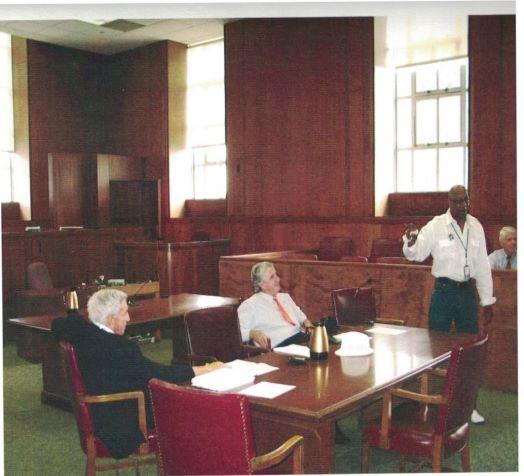
Bobby Joe Leaster, with his lawyers, Robert and Christopher Muse

Bobby Joe Leaster, with his lawyers, Robert and Christopher Muse, teaching Judicial Youth Corps students in the courthouse where he was convicted.

This is my remembrance of the person who motivated me as a student, inspired me as a lawyer, and became a friend of my family, two of whom, my grandfather Robert Muse and my uncle Christopher Muse, a longtime adjunct professor at BC Law, helped to free Bobby Joe.

Continue reading

All Hands On Deck: Silence is Violence

A couple of weeks ago, Dean Rougeau quoted Martin Luther King in his powerful letter to the BC Law community: “We may all have come on different ships, but we are in the same boat now.”

What does this mean? 

It means that not a single person in America can remain silent or apathetic in this fight for racial equality. Racism is pervasive and comes in many forms. Racism is police brutality. Racism is microaggressions. Racism is “color-blindness.” Racism is silence. 

And silence is violence. 

Continue reading

Together in a Time of Crisis

BC Law Dean Vincent Rougeau sent the letter below earlier this week to the BC Law community, and I thought it was important enough to share here on BC Law Impact. I have also written about this issue in my recent post Black Lives Matter.

Dear members of BC Law community:

I know the pain that you are feeling because I am feeling it too. And I am tired. So very, very tired. I am tired of writing these letters over and over again. As a Black man with three sons, I am tired of the fear I must carry when they are out moving through their lives in a country where the lives of people of color are so easily extinguished. I am tired of the sickening legacy of racism in this county and of being told not to talk about it because it makes people uncomfortable. Our nation is in crisis and we cannot continue to ignore the fact that the fabric of our society is being shredded by many among us who refuse to recognize our shared humanity.

Continue reading

A Jubilee Year: What Leviticus Can Teach Us Today

“Go home. Be with your family. Live simply and with integrity. Consume only what you need. Be generous with each other.”

That is the gist of much of Leviticus 25, where God issues instructions for the Jubilee. The jubilee is a kind of year-long Sabbath, occurring after “seven weeks of years, seven times seven years”—i.e., every 50th year. But in addition to the typical Sabbath’s rest and worship, the Jubilee is also a time of mercy and compassion: enslaved people are freed, debts are forgiven, and economic relations are subordinated to fundamental human needs. God assures Moses that the land will be capable of feeding and sheltering the people and so they must, “observe my statutes and faithfully keep my ordinances, so that you may live on the land securely.”[1]

Continue reading

The Pandemic, Prisoners, and the Commonwealth: Cruel and Unusual?

Today I am hosting a guest blog from third-year student Eric Jepeal.


This past August I was fortunate to be appointed to serve on the Massachusetts State Advisory Committee (SAC) to the U.S. Commission on Civil Rights (USCCR). USCCR is a federal agency established by Congress to advance “civil rights through objective and comprehensive investigation, research, and analysis on issues of fundamental concern to the federal government and the public.” USCCR is Congressionally mandated to have SACs in each state and the District of Columbia. The members of these SACs advise and facilitate the work of the USCCR, and are colloquially referred to as the “eyes and ears” of the USCCR. 

Prior to my time at Boston College, I interned for the USCCR and worked on various projects related to solitary confinement, bail reform, and fair housing. In light of the COVID-19 pandemic, our SAC released a statement of concern regarding incarcerated persons. As you may be aware, the Supreme Judicial Court recently issued an opinion regarding litigation in Massachusetts brought by prisoners’ rights advocates and organizations to provide relief to incarcerated persons in the Commonwealth (CPCS v. Chief). Unfortunately, the SJC found it lacked authority to provide relief to prisoners who are more than sixty days into serving their sentences. 

Continue reading

Businesses Want Governments on Stand-by for Coronavirus Relief

Today I am hosting the second in a series of guest blogs by Irit Tamir, an adjunct professor at BC Law who teaches Business and Human Rights. The first post is here. Professor Tamir is also the Director of Oxfam America’s Private Sector Department. In her role, she is focused on working with companies to ensure that their business practices result in positive social and environmental impacts for vulnerable communities throughout the world. She leads Oxfam America’s work on business and development including shareholder engagement, value chain assessments, and collaborative advocacy initiatives, such as the successful “Behind the Brands” campaign.


Seven years since the Rana Plaza disaster, the COVID-19 crisis is a stark reminder how businesses have a responsibility to their supply chain workers.

The COVID19 pandemic highlights, more than any recent crisis, the duty of Governments to provide social protection. For workers, social protection ensures strong labor policies, living wages, safe and healthy working conditions, and the ability to have a voice in the workplace — in particular, to raise issues when they arise without fear of retribution. It also means there is a safety net in place when disaster strikes and workers and producers are no longer able to make a living by providing unemployment compensation, sick leave, and insurance.

But, many governments have not lived up to this duty, because they lack the resources to be able to do so, they espouse a race to the bottom approach in attracting foreign investment, and/or because they have been corrupted by business sector influence.

Continue reading