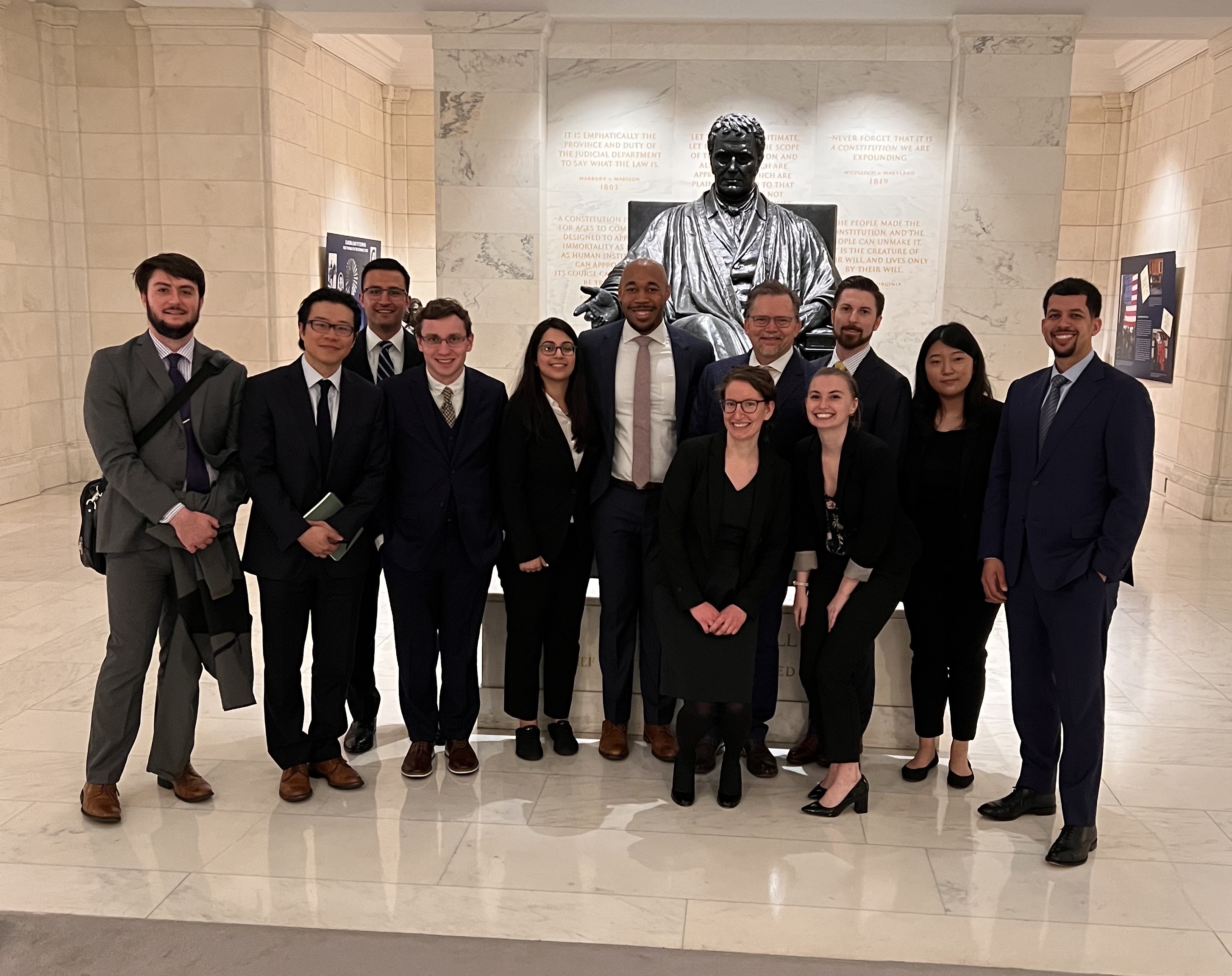
Greenfield’s Supreme Court Experience: From Boston to DC!

“One of the best classes I’ve taken at BC Law.” This is an almost guaranteed statement from any student who has taken The Supreme Court Experience with Professor Kent Greenfield. If you have the opportunity, take the class! Even if you plan to forget litigation and focus on a corporate practice (like me), take the class! Even if you are a 3L and don’t intend to “work too hard” next year, take the class!

Did I convince you already? You can apply now for Fall 2023 by filling out this form.

Continue reading

Law School Core Classes as Tatte Desserts

Tatte Bakery & Cafe is a Boston staple– with a location less than one mile from the Law School, it’s one of my favorite places to catch up with friends, splurge on a fancy coffee, treat myself to a baked pick-me-up, or do a little bit of reading with a change of scenery.

To give prospective law students an idea of what classes are like and current law students a sweet reprieve from their post-Spring Break deluge of work, I have assigned each legal core class a Tatte pastry that I feel most represents it. If your favorite class didn’t make the list, feel free to add it in the comments!

Continue reading

Spinning Through Law School

“Hype yourself up, before you psych yourself out!”  These are the words that I constantly yell at my peers . . . in the spin room. This past August, I became a certified spin instructor. My decision to become a spin instructor was encouraged by my classmate Ben Minerva. Ben knew that I was going to spin classes daily and questioned why I did not just become an instructor.  Fast forward after months of training and making playlists, and I have been teaching spin classes at Boston College’s Margot Connell Recreation Center four times a week. 

The highlights of my week have often been filled with moments from my spin classes. Spin has acted like a safe haven for me from the stresses that come with being a law student. Someone once told me that the feeling of being nervous is identical to the feeling of being excited. I use my spin classes as a way to channel my law school fueled nerves into the exciting energy that comes with teaching a spin class. My spin classes have also been a space where I have grown so much as a person. I learned how to find and use my voice, how to troubleshoot problems on the spot, and how to build trust and rapport quickly with those who barely know me. All of these lessons, in my opinion, are transferable to my legal career. 

Continue reading

Casebooks, Inc.

During my 1L year of law school I spent a good amount of time helping my dad with a construction project that had me making frequent trips up and down Rt. 128 to Home Depot. I felt like I could drive the route in my sleep. One thing that stuck out to me was a particular office building perched atop the highway—one of those blocky corporate stockades that line a particular stretch of Rt. 128, from Newton to Burlington, a liminal badlands of office parks and office buildings that are largely products of the 1980s—an area that at one point was referred to as the “Silicon Valley of the East Coast.” 

On the front of the building, glaring ominously down at the highway as if it were Wayne Enterprises or ExxonMobil or Waystar Royco, is the name “Wolters Kluwer”—a Dutch information services conglomerate, better known to us all as the maker of many of our casebooks. As 1L went on, and the brand name became an omnipresent feature of our daily studies (as well as the beneficiary of hundreds of dollars spent on textbooks per student per semester), I became curious as to what exactly this racket is all about.

Continue reading

Faculty Spotlight: Professor Mary Ann Chirba

BC Law Impact Editor’s Note: We pride ourselves at Boston College Law School on our unique community that cultivates an incredible student body with a brilliant faculty. The BC Impact Blog is launching a faculty spotlight Q&A series to highlight the members of our faculty throughout the next year.


Easily one of my favorite 1L classes has been Law Practice. Known as “LP” to all BC Law students, Law Practice focuses on teaching students the practical skills that they will use everyday in their eventual careers as attorneys. Students spend a great deal of time mastering legal writing and research, learning the Bluebook and system of legal citations as well as how to use research tools such as Lexis and Westlaw. Writing their objective office memo (a memo offering an objective analysis of a legal issue for an internal audience) is a rite of passage for BC law students, and was easily one of the hardest and most rewarding experiences of my first semester. Second semester sees a pivot to advocacy skills, with students learning the basics of oral argument and shifting to writing for an external audience such as briefs for courts.

For this week’s blog I sat down with Professor Mary Ann Chirba to learn a bit more about her background and teaching at BC. Beloved by students, Professor Chirba is a full-time member of BC’s Law Practice Faculty as well as teaching other law and undergraduate courses. 

Continue reading

A Look Back on the First Semester of Law School: Words of Wisdom from Current 1Ls

When I started law school, I had no clue what I was getting myself into. I had worked for a few years, and it was strange to think about being in a classroom and having homework again. Plus, I knew that law school was going to be a completely different beast than college, with things like the curve, outlining, and cold calls. Luckily, BC Law fosters an extremely supportive environment, including by assigning upperclassman mentors to 1Ls, and tries to give you all the tools you need for success early on. But most of what I figured out about law school was through trial and error. Therefore, I reached out to a few 1Ls with the following question to see what they learned from their first semester at BC Law.

You’ve survived your first semester of law school. Looking back, what advice do you have for your first semester 1L self?

Continue reading

Wondering if BC Law is for You? Here’s How to Find Out.

Deciding where to go to law school is no easy task. If you are anything like I was, you may still be deciding if a city or traditional campus is right for you. You also may even be wondering if you are more of an East Coast or West Coast person (or something in between). Well, lucky for you, BC Law is hosting Admitted Student Month, which kicked off on March 1! Throughout the month of March, BC will be hosting a ton of live and recorded content, which you can find out about here

Although this virtual world is not what any of us hoped for, both the administration and students have tried to find ways to connect with prospective students and share why we love BC Law, while answering any questions future students may have. One unique way that I have particularly enjoyed meeting prospective students is through the virtual coffee chats. 

Just last week, my roommate and I hosted one over Zoom and we received a number of good questions. It immediately made me realize that many of the questions we were receiving were largely due to the fact that students can’t visit campus (if this is true for you, be sure to check out the brand new virtual tour.) Although coffee chats are still taking place throughout March (and you can sign up here), I thought it would be helpful to provide a roundup of some of the questions we’ve received, as well as our responses.

Continue reading

Update: I Still Miss BC and the Free Finals Coffee

During the past spring semester, I authored a blog post about how I missed the free coffee served by the BC Law cafeteria during the final exam period. During my 1L fall semester, I relied on that free coffee like a car relies on gas or a legislative body relies on annoying words like “heretofore.” I may have broken even on my tuition costs with the way I consumed that free coffee during 1L finals.

Of course, I was missing the free on-campus coffee last spring because I was not, in fact, on campus. No one was, due to the onset of the Covid-19 pandemic.

During those early months, things were strange and unfamiliar. You could feel the tension in the air. No one quite knew how the virus would spread, how disruptive it would be, and how long it would rage. Here at BC Law, classes (rightfully, in my opinion) were shifted to pass/fail grading while students and professors acclimated to the remote learning format.

Continue reading

Five Silver Linings of Online Classes

I know I’m only four weeks into my legal education, and less than one sentence into this blog post, but I already feel compelled to start with a disclaimer.

This post is intentionally optimistic. The world has been feeling like a grim place lately. Although I’m presenting some bright sides to having class online, I don’t want to ignore the fact that the shift to online education has widened already existing educational  disparities.

With no further ado, let’s talk about some good things for a change:

Continue reading

Going Beyond Doctrine: Critical Perspectives at BC Law

When this year’s 1Ls sit down for their first Property Law class they are likely to discuss Pierson v. Post. The case concerns a dispute over who owned a wild fox killed during a hunt. Lodowick Post and his pack of hunting dogs were in pursuit of the fox, having chased it through a stretch of the town commons when Jesse Pierson suddenly intervened to kill and claim it. Post insisted that the fox was rightly his, as he and his pack of hounds had been in pursuit and were on the verge of capturing it. Pierson countered that a wild animal is no one’s property until it is definitively captured or killed.

Pierson is a 1L classic because it dramatizes the legal construction of ownership. The dividing line between the fox’s state of nature and its state as property is whatever the majority opinion says it is. More subtly, the case also dramatizes a key assumption driving much of Anglo-American property law: settling the question of ownership clarifies many of the rights and responsibilities that shape our relations as political subjects. Pierson can feel anachronistic, with the majority discussing obscure legal treatises and the minority perseverating on the noxiousness of foxes. But the case was not really about a fox.[1]

Continue reading