She was only seventeen when she realized she was pregnant. Having grown up in a predominantly white town in Ohio, she knew better than to bear a black man’s child, especially at that age. An adopted child herself, she decided someone else could provide her son a better life than a struggling high school student could. But my mother suddenly changed her mind seconds after holding me; by and large, my life’s greatest blessing. The struggles that would confront her may not have been clear at the moment, but she was willing to sacrifice plenty: forgoing college dreams, working multiple low wage jobs to put food on the table, being shunned by family for the color of her child’s skin, and most of all, being forced to do so alone. It was the nights that I awoke to her muffled sobs, seeing her still dressed in dirty waitressing clothes, that impacted me the most. I learned early on in life that the cards may not always be in your favor and that some people have to work harder to succeed. Yet by witnessing her struggle, I ultimately learned the value of resiliency and hard work. My mother’s perseverance instilled an insatiable hunger and an unrelenting drive, which ultimately would guide me through life. Continue reading
careers
You’ll Be Fine. Trust Me.
My first year of law school was hard for a number of reasons. I commuted from the North Shore everyday to avoid the debacle of finding an apartment, but this meant a ninety minute trip to school and back every day. To make my 9 am Torts class in the Fall, I would take the commuter rail into the city, and then an hourlong Green Line train ride to Cleveland Circle, where I would either pick up the shuttle or bum a ride from a fellow student heading to campus (thank you Colleen, and thank you Karla, you two saved me).
Imposter syndrome compounded my anxiety and I went from being someone who was hard on herself to someone who was impossible with herself. I was convinced that I wasn’t good enough, that I would fail my finals, and that graduating (or even making it to 2L year) wasn’t a given. I spent most of the year walking the ever-thinning tightrope of telling myself I deserved to be at BC, while not getting so confident that I would slip up and lose focus.
Then my dog died.
Toward Inclusivity and Cultural Competence
Hi everyone and happy summer! I am very pleased to be able to host a guest blog today from the BC Law Alumni Board member Ingrid Schroffner, Assistant General Counsel at the Executive Office of Health and Human Services.
I am passionate about—and feel fortunate to be able to work on—diversity and unconscious bias issues at the Executive Office of Health and Human Services (EOHHS). My cross-cultural upbringing and my experience as an Asian-American lawyer contribute to my interest in this area.
My maternal grandfather immigrated from Okinawa to Hawaii in the first part of the 20th century to work in the sugarcane fields. I attended Japanese school when I was a child, and my household was filled with Japanese culture.
I also have a cross-cultural, East-West perspective. My father is a first-generation immigrant from Salzburg, Austria. I learned German from my father (and later, in school) and spent a summer living and working in Austria with my relatives. None of my grandparents spoke English. These two diverse heritages comprise my background.
My Summer with a Judge
What’s it like to be a judge?
It’s my sixth week of working for Judge Dineen Riviezzo of the Kings County (Brooklyn) Supreme Court. Judge Riviezzo hears felony cases and Article 10 civil confinement cases. Also, every Friday, she’s in charge of the juvenile offender part, where she hears cases involving 14, 15, and 16-year-olds who would normally be heard in Family Court, but because they commit certain serious crimes, are heard in Supreme Court (but are often afforded youthful offender treatment).

View of Brooklyn from the Judge’s chambers
So far, I can say that being a judge requires three major qualities.
First, it requires patience. Whether it’s dealing with an attorney’s mistake, sorting out a disagreement between the parties, or waiting for a defendant to be produced or parties to show up, I’ve learned that for judges, every day is a test of patience. Continue reading
The Primacy of BC Law Clerks
Hi everyone! I am very pleased to be able to host a guest blog today from the Hon. Denis Cohen, BC Law ’76 and a judge in the Philadelphia County Court of Common Pleas, the top level trial court in Pennsylvania.
What do I do now?
It was the fall of 2000. Tom Ridge, who was Governor of Pennsylvania at the time, appointed me as a Court of Common Pleas Judge (the top level trial court in Pennsylvania), and I was confirmed by the State Senate. I was about to preside over many trials. What should my next step be—and what about hiring for that all-important position of law clerk?
As the president of the BC Law Alumni Association’s Philadelphia-Area chapter, I thought it would be great to have a BC law graduate serve as my clerk. Given the distance from Philadelphia to Boston, I didn’t know if that would be possible. I contacted the Director of Career Services, who was thrilled that I had reached out. She knew a recent alumnus who wanted to practice in Philadelphia. Before I knew it, I was interviewing Gabriel. He was impressive, so I hired him.
Watch BC Law Students Argue at the Ninth Circuit Court of Appeals!
As part of BC Law’s Center for Experiential Learning Ninth Circuit Appellate Program, four of our third-year law students prepared briefs and argued today in front of the 9th Circuit Court of Appeals on behalf of indigent clients.
In the Ninth Circuit Appellate Program, supervised law students prepare briefs and argue immigration cases brought by indigent clients who would otherwise be without counsel. The Ninth Circuit Court of Appeals, headquartered in San Francisco and hearing cases arising from Alaska, Hawaii, Washington, Oregon, California, Montana, Idaho, Nevada, and Arizona, screens pro se cases and selects those that present important issues that deserve further development. Past cases have included asylum, withholding, Convention Against Torture claims, questions relating to immigration consequences of criminal convictions, and issues of statutory interpretation that present questions of first impression to the Court.
The Court schedules the opening brief to be filed in October, the reply brief in January, and oral argument before a panel of sitting judges in April of the same academic year. Students travel to the court hearing to present oral argument. The Court then issues its decision based on the merits of the individual cases.
Students develop and apply numerous skills, including client communication, legal research, brief writing, and oral advocacy.
These students have been preparing all year for this day, and you can watch their arguments here:
Why PILF’s Annual Auction is Awesome

BC Law’s Public Interest Law Foundation (PILF) hosted its 28th annual auction last Thursday at the offices of Morgan Lewis in downtown Boston. The auction is PILF’s biggest event of the year and is always well-attended by students, professors, and alumni.
As a 1L attending my first PILF auction, I found it to be pretty awesome for two main reasons.
Meet the Affinity Group Leaders: Amani Kancey (BLSA)
Name: Amani Kancey
Year: 2017 (2L)
 Organization: Black Law Students Association (Co-President)
Undergraduate Institution: Howard University
Experiences between college and law school:
Upon graduating from Howard University I served as a White House Intern. After my internship, I was appointed by the White House to work at the U.S Department of Transportation as a Political Appointee. For two and a half years I was Special Assistant to the U.S. Secretary of Transportation.
Favorite event that your organization plans:
My favorite event that BLSA hosted this year was “Black Excellence: A Celebration of Black History in Academia and the Legal Profession”. Black Excellence featured our Black deans and faculty sharing their personal stories in life and practice.
In BC Law’s Classrooms, Experiential Meets Academic
It goes without saying that BC Law offers a broad range of challenging classes, taught by wonderful faculty committed to producing lawyers who strive not only to win cases, but to serve their communities as well. And there is no shortage of ways to get your fill of experiential learning here–whether you participate in one of our top rated clinical programs, or are involved in an externship or moot court program, BC Law offers a multitude of ways to learn the law outside of the classroom.
But more and more experiential learning is happening inside the classroom itself.
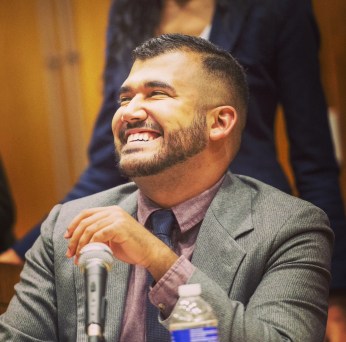
Meet the Affinity Group Leaders: Dallas Taylor (BLSA)
Name:
Dallas Taylor
 Year:
Year:
2017 (2L)
Organization:
Black Law Students Association (BLSA) Co-President
Undergraduate Institution:
University of Missouri- Kansas City
BA, Political Science
Experiences between college and law school:
I took 3 years off after high school before going back to college. In that time I traveled with a music group and worked with a young adult leadership organization. After undergrad I went straight into law school.
Favorite event that your organization plans:
Culture shock. The event is amazing because it gives law students a candid opportunity to talk about social issues in a safe environment.
 BC Law: Impact