My Sister Sarah: A #BCLawImpact Story

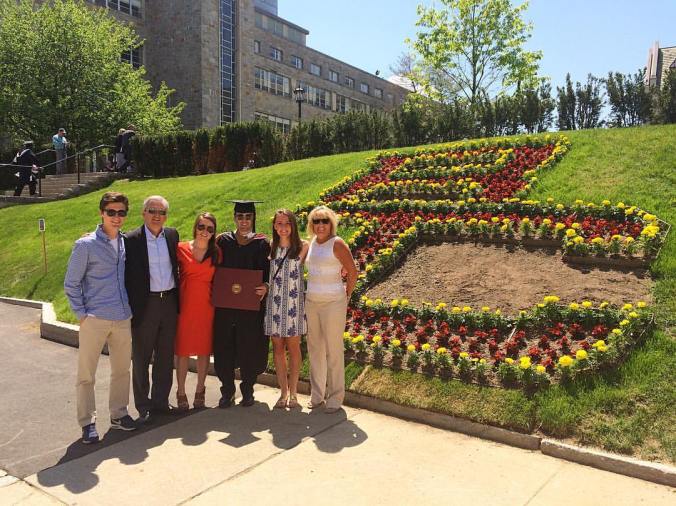
Not long after graduating from college my sister, Sarah, who recently entered her 30s, found herself at a convent in Port-au-Prince, Haiti, helping the nuns run an orphanage. She wasn’t taking vows, but she was beginning, unbeknownst to her, a life path focused on service to others. She has spent the bulk of the past five years working for the Human Resources department for Doctors Without Borders (Medicins Sans Frontiers, MSF).

When I think of HR, I think of Toby from the show The Office. That was not my sister’s HR. She spent months working in Kurdistan, the Democratic Republic of Congo, South Sudan, and Haiti again, to name a few. These are not vacation destinations, and that’s in part what drew her to the work: the ability to go into Afghanistan to work with and learn from a culture that most folks will never get to experience. Her HR department is likely unlike those that you have worked with. One of her first assignments was to maintain a list of every employee’s location for MSF’s entire 120-person mission in South Sudan, in case they needed to evacuate the country. Every day, she would email or call to each field hospital to see who was moving where, so that if disaster struck and the entire team needed to leave the country quickly, they could. She was barely twenty-four.

This week, the Impact blog is showcasing those people in our lives who have made an impact on us, who have helped us arrive at where we are today, and who keep us motivated towards our goals in the future. If you want to share a story about that person in your life, join us on Twitter, Facebook, or Instagram, and post your story using the hashtag #BCLawImpact. Students from the Law Students Association (LSA) and the blog will be in the Yellow Room on Thursday at lunch with a BC Law backdrop and a dry-erase board so you can take a picture with a message thanking someone who has made an impact on you and post it. We will post some of our favorite pictures and messages on the blog, and they will be collected in a Tagboard.

Continue reading

The One Shift That Could Change the War on Drugs

After I wrote about the failures of the War on Drugs for BC Law Magazine last semester I waited anxiously for the backlash. I spent ten years in the U.S. Coast Guard before law school, six of them chasing international drug cartels at sea, and I had the opportunity to work with some of the most professional and dedicated military and law enforcement personnel in the world. I was terrified about how they’d respond when I called the drug war a “lost cause,” and it took less than a day for the responses to start flooding my inbox. The volume wasn’t surprising, but the content shocked me.

Continue reading

Goodbye to OCI

No, that noise you hear as the calendar flips to November isn’t the sound of leaves blowing in the fall wind. Rather, it it a collective sigh of relief coming from BC Law 2Ls that the OCI process has finally come to a close. OCI, short for “on campus interviewing,” serves as the major recruitment tool for most large, national firms looking to hire summer associates. Over the summer, 2L students may submit resumes, cover letters, and transcripts to all of the firms that they are interested in interviewing with. The firms then select students they wish to meet with for screener interviews on the law school campus. These initial interviews are about twenty minutes long and are generally a way for firms to get a feel for whether or not the candidate is a good “fit.”

Continue reading

What Exactly Is Art Law, Anyway?

I’m pleased to host a guest post from Samantha O’Neal, one of the leaders of BC Law’s Art Law Society.

It is a universally acknowledged truth that a college student majoring in Classics and Archaeology will be the subject of much familial concern and consternation, especially if that student has little desire to actually be an archaeologist. I was one of those students. Few moments can be as uncomfortable as your friends’ parents staring at you while wondering aloud, “But what are you going to do with that?” as they try to mask their sympathy for my poor, long-suffering parents who would probably be supporting me forever thanks to my desire to study a “dead” language (I’ll forego listing the merits of a Classical education for the moment.)

I had the great fortune to be born to parents who, while most certainly long-suffering, champion the Liberal Arts education. They always figured that, regardless of what I wanted to do, I would either need to go to grad school or be trained on the job, so why not study something I was actually interested in? But I never saw undergrad as some carte blanche to major in anything I wanted. Rather, it was an important step in my journey to studying museums and cultural property law.

Continue reading

Behind Closed Doors

When people asked me about my summer (How was work? Did you like what you did?), I found it difficult to provide an adequate account of what I was doing. I spent my summer with the Child Protection Unit at the Suffolk County District Attorney’s office. The Assistant District Attorneys (ADAs) there form part of the team that investigates and, if appropriate, prosecutes instances of child physical and sexual abuse in Suffolk County, which includes Boston, Revere, Chelsea, and Winthrop. At the Superior Court level almost all of the cases they handle deal with allegations of sexual abuse involving children. To be clear, the following will include a discussion of those cases, and some of it may be difficult to read. Continue reading

Want to Practice in New York?

In the summer of 2016, I was faced with a dilemma: should I attend law school at BC, a school that I absolutely love, and at which I know I’ll receive a quality education? Or should I attend law school in New York – my home city, and the city where I want to eventually practice law – even though the school has a lower ranking?

After months of deliberation, speaking with lawyers and law students, and prayer, I decided to attend BC Law. I was convinced that it was the best place for me to receive the education I need to be a good lawyer, and to also enjoy the law school experience (and as a rising 3L, I can say that I was right!). However, a concern still lingered in my mind throughout my 1L year: will I be able to find a job back at home in New York City once I graduate? This blog post is for any prospective or current students who are wondering the same thing.

Continue reading

Criminal Justice Reform Tackled at BC Law

At BC Law, your education does not only consist of the material you learn in your courses. BC hosts many conferences, functions, presentations, and discussions on just about every subject you can think of, from panels put on by professors addressing recent political actions to all-day events sponsored by BC’s journals and the Rappaport Center for Law and Public Policy. Recently, the Rappaport Center sponsored an all-day conference on criminal justice reform in Massachusetts that was open to both students and practitioners. There were three panels as well as a keynote address by Chief Justice Ralph D. Gants of the Massachusetts Supreme Judicial Court.

Continue reading

Through the Eyes of a Child

If you are ever looking for a brutally honest opinion of yourself, swallow your pride and ask a five year old.

In the years I spent working with kids at a community non-profit, I had the pleasure of hearing such gems as, “Miss Morgan, your tummy looks like my mommy’s when there’s a baby inside!” and “Did you know you look a lot less pretty when you wear your glasses?” Though some took these remarks seriously, one look at the sweet little faces from which the comments sprang forth never failed to make me laugh out loud. The children who attended these programs, often with the help of scholarships and sliding-scale payment plans, were typically filled with a joy and sense of innocence that made me absolutely love my job. All too often, however, these amusing little observations were juxtaposed with unfettered comments about living situations that revealed just how much these kids had been through in their short lives. I cannot forget the five-year-old who told me she wanted to kill herself because she missed her father so much, or the look of shame in an eleven-year-old’s eyes when his mother arrived to pick him up while high on drugs. I often felt frustrated by my inability to help these kids beyond passing the information along to DCF. I wanted so desperately to be able to advocate for these children in a way that went beyond simply telling someone higher up than me.

Continue reading

Our Alumni Association Network

I’m pleased to host today’s blog from Kenneth Sanchez ’03 and Dionna F. Shear ’14, the co-chairs of the Los Angeles chapter of the BC Law Alumni Association. Our alumni network is one of the strongest in the country, and I think their post gives you a sense of our alumni’s commitment to each other and to new generations of students.

Life after law school can get very busy, very fast. After three years of law school and the associated neurosis, stress, and countless nights of no sleep, you get to do it all over again. Life as a practicing attorney can be even more stressful when balancing the needs of your clients, meeting minimum billables, and trying to maintain some kind of social life outside of work.

Who has the time to do anything else? Who wants to mingle with other lawyers after spending the entire day dealing with them? What could my law school possibly have to offer me beyond a legal education? The answer to all that is very simple. Alumni should be involved with their alumni association because besides your education, the most valuable thing your law school offers you—and the students who come after you—is a network.

Continue reading

Humans of BC Law: Professor Martin O’Malley

omalley-1050x700

“I think you’re going to see more young people running for office for the first time in these next elections than ran for the first time inspired by President Obama’s success. … In my experience on the presidential stage — a tour that was shorter than I would have hoped — it seemed that anger and fear were the animating emotions of the entire election.

Continue reading