The Real Reason to Become a Prosecutor

This guest post was written by 3L Alyssa Hatfield.


“Alyssa Hatfield on behalf of the Commonwealth.” 

As introductions go, this one might be the most terrifying. What does it mean to represent the Commonwealth? To represent an entire group of people, the defendant included? It’s a heavy weight to bear, but it’s not meant to be borne alone. 

This semester, I joined the Prosecution Clinic. As a part of the clinic, you learn a few things really fast. One: court moves really quickly. Like, really quickly. Two: how to swap stories like old-timers, because people commit some pretty odd crimes in some pretty odd ways that are ripe for class discussion. And three: to “do justice” might be the hardest and most unattainable mission to live by.

Continue reading
Empathy: The driving force of entrepreneurship

For people facing long odds, an entrepreneurial mind-set matters

This post was originally published in the Boston Business Journal. Authors & Innovators is a regular column by Larry Gennari, a transactional lawyer, BC Law adjunct professor and founder of Project Entrepreneur, and chief curator of Authors & Innovators, an annual business book and ideas festival.


About 77 million Americans have a criminal record. Experts expect that number to be 100 million by 2030. For the estimated 600,000 people returning home from incarceration annually, a criminal record creates substantial barriers to obtaining housing, employment, government benefits and continuing education, due to myriad federal and state restrictions. Getting an ID and finding a job — any job — are immediate priorities. No surprise that recidivism rates for returning citizens range from 29% to 59%, depending on the state.

Continue reading

The Vital Lessons I’ve Learned in BC Law’s Clinics

Last month, as part of BC Law’s Immigration Clinic, my clinic partner and I advocated for our client’s release from detention during a bond hearing in front of an immigration judge, and were denied. Given his circumstances of indefinite long-term incarceration and mental illness, this denial was heartbreaking and unjust in more ways than one. I dreaded making the call to my client to discuss the outcome of the hearing and our next steps. I expected to hear intense sadness and frustration, and I certainly would not have blamed him if he took part of that out on me. But instead – though he was undeniably sad – he told me that my argument was perfect and exactly what he would have wanted to say if he were able to speak during the hearing. He expressed his gratitude for all our hard work and representation, despite the outcome. Of all the responses I imagined, this perhaps shocked me the most.

Continue reading

A Glimpse into the Human Side of Justice: Visiting District Court

The sky wears a cloak of gray. Snow falls, then melts. Indoors, the instant coffee offers warm sips of solace. Heaters hum in a clunky staccato. It is winter in Boston, and the start of the spring semester. 

This week, on another familiarly cloudy day, my criminal justice class and I visited the Worcester District Court where we had the privilege to speak with a judge and observe her presiding over arraignments. The building’s drab architecture echoed the nature of its solemnity. Inside, people spoke in hushed tones, only interrupted by claps of footsteps on marble and the occasional beep of a metal detector. We sat in the back of courtroom 14. Here, the air felt thick, with a sense of gravity and respect.

Continue reading

Five Christmas Songs as Law School Classes

While it may be finals season, it is also the holiday season. And what better way to spread some holiday cheer (and fight some finals fear) than with Christmas songs as law school classes. 

Torts: “Grandma Got Run Over By A Reindeer”

A classic Christmas tort. Wonder how the reindeer is going to pay for those compensatory damages. 

Family Law: “I Saw Mommy Kissing Santa Claus”

Mommy may need a divorce lawyer pretty soon. Hopefully her prenup didn’t have an enforceable infidelity clause. 

Contracts: “Santa Claus is Coming to Town”

He’s making his offers and he’s checking them twice. If you’re nice, you’re getting a gift – a promise with consideration? 

Property: “12 Days of Christmas” 

Three french hens, two turtle doves, the property interests are growing by the day! 

Criminal Law: “Baby It’s Cold Outside” 

Once described as “an ode to statutory rape,” controversy around this carol has prompted a more consensual rewrite by John Legend and Kelly Clarkson.


Sangeeta Kishore is a first-year student at BC Law. Contact her at kishorsa@bc.edu.

Law School Core Classes as Tatte Desserts

Tatte Bakery & Cafe is a Boston staple– with a location less than one mile from the Law School, it’s one of my favorite places to catch up with friends, splurge on a fancy coffee, treat myself to a baked pick-me-up, or do a little bit of reading with a change of scenery.

To give prospective law students an idea of what classes are like and current law students a sweet reprieve from their post-Spring Break deluge of work, I have assigned each legal core class a Tatte pastry that I feel most represents it. If your favorite class didn’t make the list, feel free to add it in the comments!

Continue reading

It’s been 146 Days Since Breonna Taylor Was Killed

It’s been 146 days since Breonna Taylor was killed. Kentucky’s Attorney General, Daniel Cameron, still has not filed any charges against the Louisville Police Department officers who killed her. Here are some statutes that deserve attention:

Murder (Ky. Rev. Stat. § 507.020):

A person is guilty of murder when: (a) With intent to cause the death of another person, he causes the death of such person or of a third person.

Reckless Homicide (Ky. Rev. Stat. § 507.050):

A person is guilty of reckless homicide when, with recklessness he causes the death of another person.

First Degree Manslaughter (Ky. Rev. Stat. § 507.030):

A person is guilty of manslaughter in the first degree when: (a) With intent to cause serious physical injury to another person, he causes the death of such person or of a third person; (b) With intent to cause the death of another person, he causes the death of such person or of a third person under circumstances which do not constitute murder because he acts under the influence of extreme emotional disturbance, as defined in subsection (1)(a) of KRS 507.020; or

In Criminal Law, we were taught to break down and work through each element of a criminal statute. Essentially every class was devoted to identifying the elements of a crime, gathering the facts of the case, and analyzing the case by connecting elements to facts. Our professor was a practicing defense attorney so she kept us on our toes and we learned to take nothing for granted. For the sake of brevity, and at the risk of incurring her wrath, I am just going to say that the uncontested facts of this case easily satisfy the actus reus (guilty act) element of these statutes.[1] No one is denying that these police officers caused Breonna Taylor’s death.

Continue reading

Remembering Bobby Joe Leaster: Saving Boston’s Youth

Guest blogger Rita Muse ’15 comes from a line of BC Law graduates. Her grandmother, Judge Mary Beatty Muse, graduated in 1950, her aunt, Patricia Muse, in 1990, and her cousin, Julie Muse-Fisher, in 2005. Her uncle, Christopher Muse, though not a BC Law grad, has been a longtime adjunct professor at the Law School. He and Rita’s grandfather, Robert Muse  were instrumental in the release of the wrongly convicted Bobby Joe Leaster. Their engagement with Leaster in the 1980s had a lasting impact on the Muse family, including on Rita, who, as a law student, helped to free another innocent man.  


Bobby Joe Leaster: A Remembrance
By Rita Miuse ’15

When Bobby Joe Leaster spoke to BC Law students and faculties, his story was the same but his message never got old; he was wrongfully convicted of murder and unjustly imprisoned for almost 16 years, but he dealt with injustice in his own profoundly special way. This past April 26, one of BC Law’s favorite guests and a beloved citizen of Boston, passed away from the severe burns he suffered in a home fire three weeks earlier.

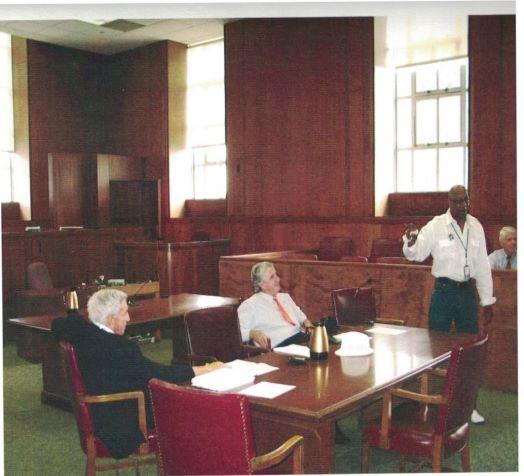
Bobby Joe Leaster, with his lawyers, Robert and Christopher Muse

Bobby Joe Leaster, with his lawyers, Robert and Christopher Muse, teaching Judicial Youth Corps students in the courthouse where he was convicted.

This is my remembrance of the person who motivated me as a student, inspired me as a lawyer, and became a friend of my family, two of whom, my grandfather Robert Muse and my uncle Christopher Muse, a longtime adjunct professor at BC Law, helped to free Bobby Joe.

Continue reading

BC Law’s Spring Break Pro Bono Trips: Executing Law in Alabama

In the past few weeks the world has changed in ways most of us could never have imagined. While much remains unknown, one thing remains stable—the sense of community that both comforts and uplifts us, even in the midst of trying times.

The post below is a riveting reflection from 1L Ryan Kenney, who was among a group of BC Law students on this year’s Gulf Coast Pro-Bono Spring Break trip to Montgomery, Alabama. It was scheduled to be posted several weeks ago, but was postponed due to the emergency situation COVID-19 created. That said, we think the message is too important to go unshared. We will share several other related service trip stories this week.

Stay safe everyone, and please reach out to us at bclawimpact@bc.edu if we can do anything to help, or if you would like us to consider publishing a guest post on your own experiences during the outbreak.


When people asked us where we were from and we replied that we were on spring break from Boston College Law School, gently raised eyebrows and clarifying questions invariably followed. As if on cue, our neighbor on the puddle jumper from Charlotte, then the barista, the lobbyist in the state house elevator, and virtually everyone else we encountered who wasn’t already expecting us conferred a “Well, welcome to Alabama!” and a warm smile.

This week, we witnessed how people make, interpret, and execute laws in Alabama.

Continue reading

Why I Went to Law School

Growing up, I always said I wanted to be a lawyer. Both my dad and my stepmom were lawyers and I always loved to write. When it came time to take the LSAT and write a personal statement, however, I began to rethink this career choice and decided to wait to apply.

In April 2015, right before my college graduation, I received one of the worst phone calls of my life. I learned that someone close to me had been sexually assaulted. Although the details were fuzzy, she decided to take all the available steps she could. She went to the hospital where a rape kit was performed, she reported the rape, and decided to move forward with pressing charges.

When this case was unfolding before my eyes, I constantly had more questions than I did answers. I could not understand what additional evidence the prosecutor “needed” before pursuing the case, the standard of proof—guilty beyond a reasonable doubt—meant very little to me, and the perpetrator’s ability to walk away with a misdemeanor charge seemed unjust.

Simply put, this was the most difficult time in my life. My emotions were everywhere and I felt stuck in a position where I was unable to help. But finally, I discovered the true reason why I wanted to be a lawyer.

Continue reading