Note: this is the second in a two-part guest post series from BC Law 3L Edwin Ward. Read part one.
Day 5: 12/11/23
Welcome back to the second half of my experience as an observer with the Boston College delegation to the UN Climate Conference. If you haven’t read the first half, you can do so here.
Monday was a rest day for many on the BC delegation, including myself. Rest of course, is a misnomer, as it only means I had to briefly return to the reality of finals season at BC Law—performing a policy and plan analysis of car-centric infrastructure in Syracuse, NY, writing a paper on how US tax law can incentivize more lobbying by environmental organizations to fight back against fossil fuel lobbying, and studying for my international law final. Although it felt odd doing schoolwork in Dubai, it was such a privilege to be able to do it inside the awe-inspiring dome of Al Wasl Plaza.
Not everyone rested, however, with some on the BC delegation attending civil society protests and learning about systems change, mental modeling, and cognitive systems. Some of the faculty members took what they learned to begin developing expanded curriculum for Boston College involving all facets of climate change. One faculty member was even able to arrange a one-on-one sit down with the head of Bulgaria’s national delegation.
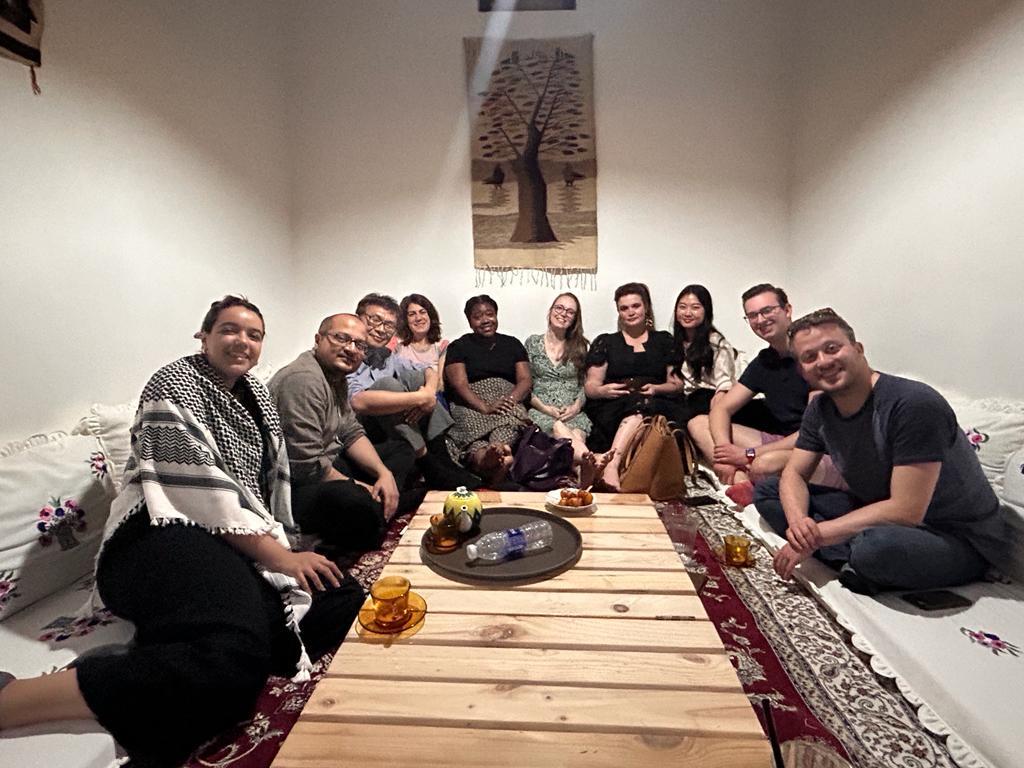
In the evening, the entire BC delegation made its way to Al Kahmya Heritage Restaurant in historic Old Dubai, where we dined on traditional Emirati food and Zoomed in for a Q&A session with BC students and staff at the Schiller Institute for Integrated Science and Society.

Day 6: 12/12/23
As the last scheduled day of COP28, and our last full day in the UAE, the conference was supposed to wrap up at 11 am GST. A recurring feature of the annual UN Climate Conference, however, is the near guarantee that negotiations will not be completed on schedule. As expected, 11 am came and went as the west and small island developing states (SIDS) were in intractable opposition with OPEC countries—the latter of which refused to sign an agreement that phases out fossil fuels and the former refusing to sign an agreement that doesn’t phase out fossil fuels.
As an instrumentality of international law, the framework convention on climate change requires full consensus, not merely majority support. In the context of the recent bout of unproductivity in our Congress, it might seem impossible trying to get buy-in from a cast of countries as varied as Azerbaijan and Australia, and Russia and Romania. The enormity of the climate crisis demands action, however—even if that action is slow-moving.
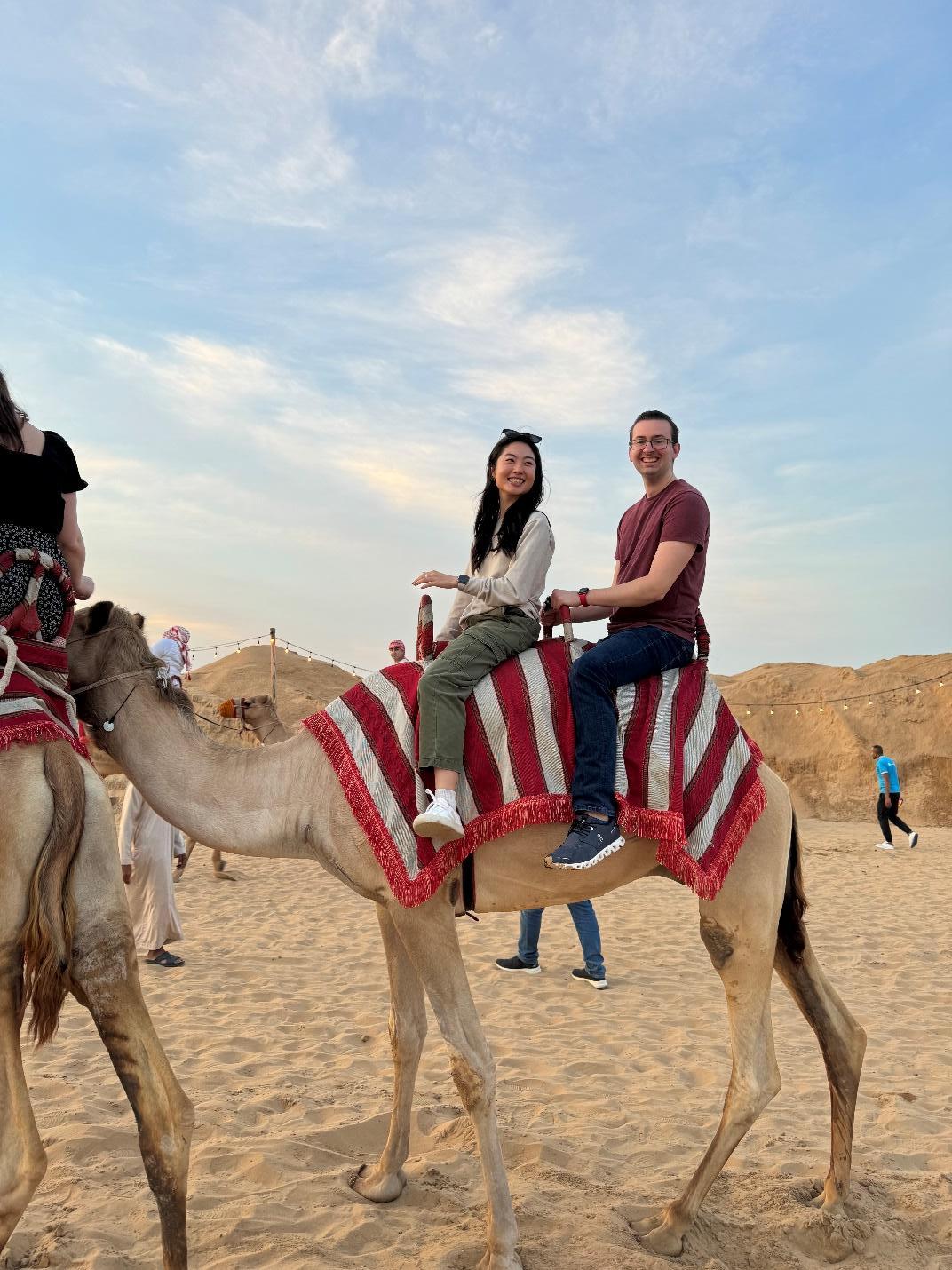
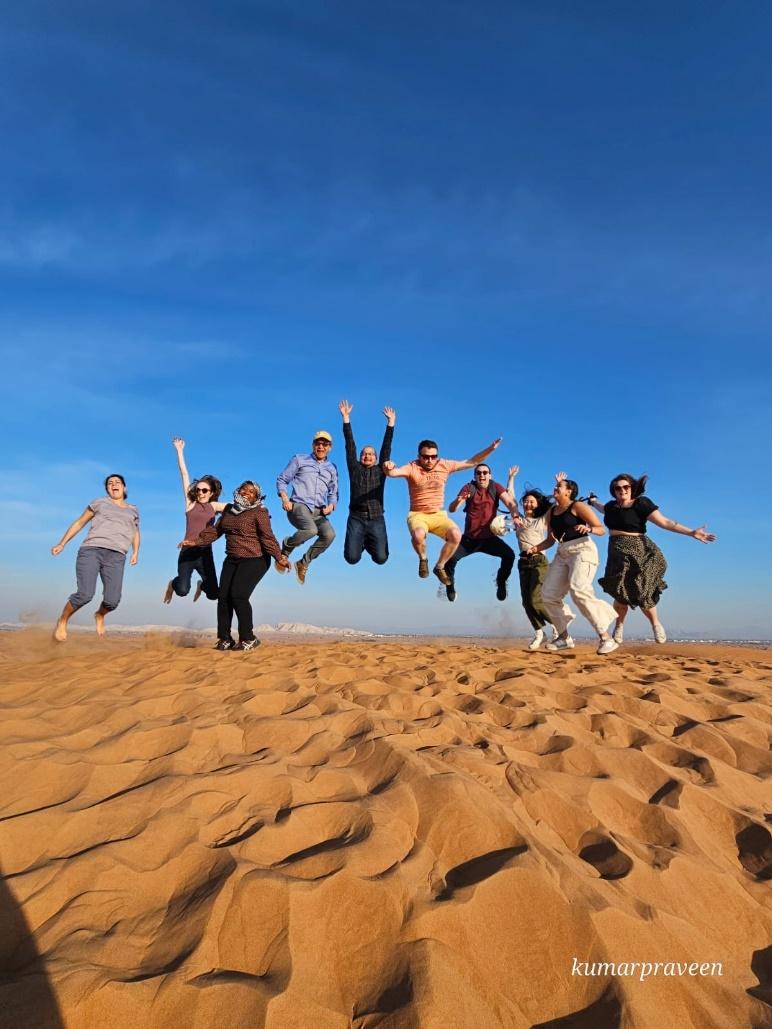
With the end of formally scheduled events at 11 am, it would have been challenging for the BC delegation to get seats in the packed plenary, so we did the next best thing: we rode camels! We also experienced “dune bashing,” went “duneboarding,” and explored the Lahbab Desert near the Oman border.

Day 7: 12/13/23
As we dragged ourselves out of bed for our 5 am airport shuttle, we were oddly left without a feeling of closure. We had flown 7,000 miles to see through a global agreement on climate change—and now we were leaving without one. Thankfully, that feeling evaporated when, at 11:45 am GST, while flying somewhere over rural Kazakhstan, I received word that a final agreement for COP28 had been unanimously ratified.
The final agreement is far from perfect—it fails to incorporate the language of a phase down or phaseout of fossil fuels. But it is nevertheless something humanity can be proud of. As the single most ambitious global climate agreement in history, the COP28 agreement creates a loss and damage fund to help developing countries prepare for and respond to climate disaster, with nearly $1 billion already pledged. COP28 also sets specific targets for tripling renewable energy output and doubling energy efficiency investments by 2030. Finally, and most importantly, the COP28 agreement is the first time ever that the nations of the world have agreed to transition away from fossil fuels.
The specific language of the agreement deserves to be restated here: “The Conference of the Parties serving as the meeting of the Parties to the Paris Agreement…further recognizes the need for deep, rapid and sustained reductions in greenhouse gas emissions in line with 1.5 ºC pathways and calls on Parties to contribute to the following global efforts…Transitioning away from fossil fuels in energy systems, in a just, orderly and equitable manner, accelerating action in this critical decade, so as to achieve net zero by 2050 in keeping with the science.” This language is groundbreaking. Never before has the term “fossil fuels” been so much as mentioned in a COP agreement.
The Boston College delegation played an important role at COP28, as the U.S. is one of only a few national delegations without an official youth contingency. This is due to the fact that only federal government staff are permitted to be part of our national delegation. As such, we found ourselves as part of the de facto youth delegation from the United States, and were able to engage with students and negotiators from dozens and dozens of countries over the course of one week.
While it’s unlikely that any one of us materially impacted the final language of the COP28 agreement, that doesn’t mean that the work we did wasn’t incredibly valuable. As a result of this delegation, our ideas on everything from climate education to just transition were incorporated into youth demands presented to the plenary of nations. Faculty on the main campus are now working to develop a climate finance curriculum for economics students and broaden climate education more generally. I look forward to incorporating what I’ve learned into the course I’m teaching to undergrads next semester as part of BC Law’s Environmental Law Teaching Program. And on February 2nd, 2024, the entire delegation will be hosting a symposium to share insight about the UN Climate Conference to the wider BC community (I hope to see you there!).
In my final dispatch from Dubai, I need to take the opportunity to thank everyone who made this trip possible. First, the entire delegation: from our first week undergrad team who laid the groundwork, to the amazing faculty and grad students who taught me so much about climate change’s interdisciplinary impacts, to Praveen Kumar and María Fernanda Piñeros-Leaño, who spent the entire semester preparing us for Dubai. Second, the Schiller Institute team who made the entire trip logistically possible: especially Greg Adelsberger and Jim West. Third, BC Law Professor David Wirth, for getting the BC delegation started three years ago and for his mentorship this semester. And finally, Leila Ismaio, my BC Law delegate-in-crime.
Since I was fifteen years old, I’ve known that I wanted to make a difference in environmental policy and law. Attending as part of Boston College’s delegation not just any COP, but the COP where the nations of the world agree to finally end the era of fossil fuels, is a dream come true. Thank you so much for following along, and to all current students, good luck finishing up finals! I’d say it’s time for me to finally rest—but there’s no rest to be had when there’s a planet left to save!
Edwin Ward is a third-year law student at BC Law. Contact him at wardeu@bc.edu.
 BC Law: Impact