The Ambiguity of Probable Cause: My Path to Law School

This guest post is by Dave Sainte-Luce, a brand new 1L student at BC Law.

My fascination with law enforcement stretches as far back as my childhood. I was your normal cop-loving kid, who always perked up and watched in awe as those Ford Crown Victorias roared by with their sirens blaring and lights flashing. With each visit to the store, I could never leave without convincing my dad to buy me a new toy police car. At that age, I only understood cops as being brave and strong, running headfirst toward danger to fight crime and maintain law and order. Accordingly, I thought all criminals deserved to be punished, and the cops did the dirty work of putting the bad guys away to keep our community safe. With such a simple yet honorable equation, how could I not love the police?

Continue reading

Surprise! USF Decision Signals Admin Law Revolution, But Not the One We Expected

This guest post by BC Law Professor and Associate Dean of Academic Affairs Daniel Lyons first appeared in the AEIdeas Blog.

Late last month, the Supreme Court decided FCC v. Consumers Research. Although an undercard among the Court’s last-day decisions, the case was closely watched in administrative law circles as a potential vehicle for revitalizing the moribund Nondelegation Doctrine. But as predicted after oral argument, the Court found this was not the right case to do so. The big surprise was Justice Kavanaugh’s concurrence, which likely killed future efforts to reform nondelegation, but also signaled big news ahead for the law governing independent agencies.

Continue reading

So, Are We Gonna Ban TikTok, Or…?

This guest post by BC Law Professor and Associate Dean of Academic Affairs Daniel Lyons first appeared in the AEIdeas Blog.

It has been 373 days since Congress enacted the TikTok divest-or-ban law, 105 days since the Supreme Court unanimously upheld the law as constitutional, and over three months since the ban was scheduled to take effect. Yet except for a brief Inauguration Day interruption, the Chinese-controlled app has been, and remains, readily available in the United States, collecting data on 170 million Americans—data that could potentially be exploited by foreign adversaries.

Continue reading

The Supreme Court Seems Unlikely to Revive Nondelegation Doctrine in FCC Case

This guest post by BC Law Professor and Associate Dean of Academic Affairs Daniel Lyons first appeared in the AEIdeas Blog.

Earlier this month, I previewed the arguments in Federal Communications Commission v Consumers’ Research. The case asks the Supreme Court whether the FCC’s Universal Service Fund (USF) violates the nondelegation doctrine, which prohibits Congress from delegating the legislative power to executive branch agencies. As my previous post explains, nondelegation is a largely toothless doctrine, mostly dormant since 1935. But in recent years, five of the nine Supreme Court justices have expressed an interest in revitalizing the doctrine, given the right case in which to do so.

Continue reading

Will FCC v. Consumers’ Research Revive the Nondelegation Doctrine?

This guest post by BC Law Professor and Associate Dean of Academic Affairs Daniel Lyons first appeared in the AEIdeas Blog.

The idea behind the nondelegation doctrine is sound: Congress should not delegate legislative power to executive branch agencies. But its implementation leaves much to be desired. Nearly every nondelegation case acknowledges there’s a theoretical boundary but then finds that Congress hasn’t crossed it here. Only twice has the Supreme Court found a law violated the nondelegation doctrine, in 1935, both involving a statute that literally allowed President Roosevelt to cartelize the entire economy and make rules at whim. The modern rule allows Congress to give agencies significant authority as long as it includes an “intelligible principle” to guide exercise of that authority. Perhaps more than any other doctrine, this toothless standard has permitted the modern atrophy of our legislative branch, concentrated power in unelected bureaucrats, and enabled the imperial presidencies of the 21st century.

Continue reading

Net Neutrality, and other FCC Initiatives Jeopardized Post-Chevron

This guest post by BC Law Professor and Associate Dean of Academic Affairs Daniel Lyons first appeared in the AEIdeas Blog.

It has been a big week for tech policy at the Supreme Court. As my AEI colleague Clay Calvert discussed, the NetChoice cases endorsed social media platforms’ First Amendment right of editorial control. But for the Federal Communications Commission (FCC) and other agencies, Loper Bright, which overturned Chevron, looms largest. The FCC in particular has long benefited from Chevron’s command that agencies, not courts, are the primary arbiters of an ambiguous statute’s meaning. Overturning this regime, and restoring that authority to courts, is likely to pose additional challenges for net neutrality, digital discrimination, and other FCC initiatives that capitalized on ambiguous language to accomplish the agency’s policy objectives.

Continue reading

Legal Listening: More Perfect

My first introduction to podcasts was in my AP Biology class years ago. The science podcast, Radiolab, was full of wonder and fed my curiosity. It felt personal, like telling a story. And I could tune in wherever I was, while I did whatever I was doing.  

Many years later, I’ve listened to podcasts about all sorts of things: fashion, foreign policy, even wellness. But now, in my first year of law school, I’ve been using podcasts as a way to explore the legal landscape beyond the dense casebooks. And there is no better full-circle moment for me than a Radiolab spin-off, More Perfect.

Continue reading

Greenfield’s Supreme Court Experience: From Boston to DC!

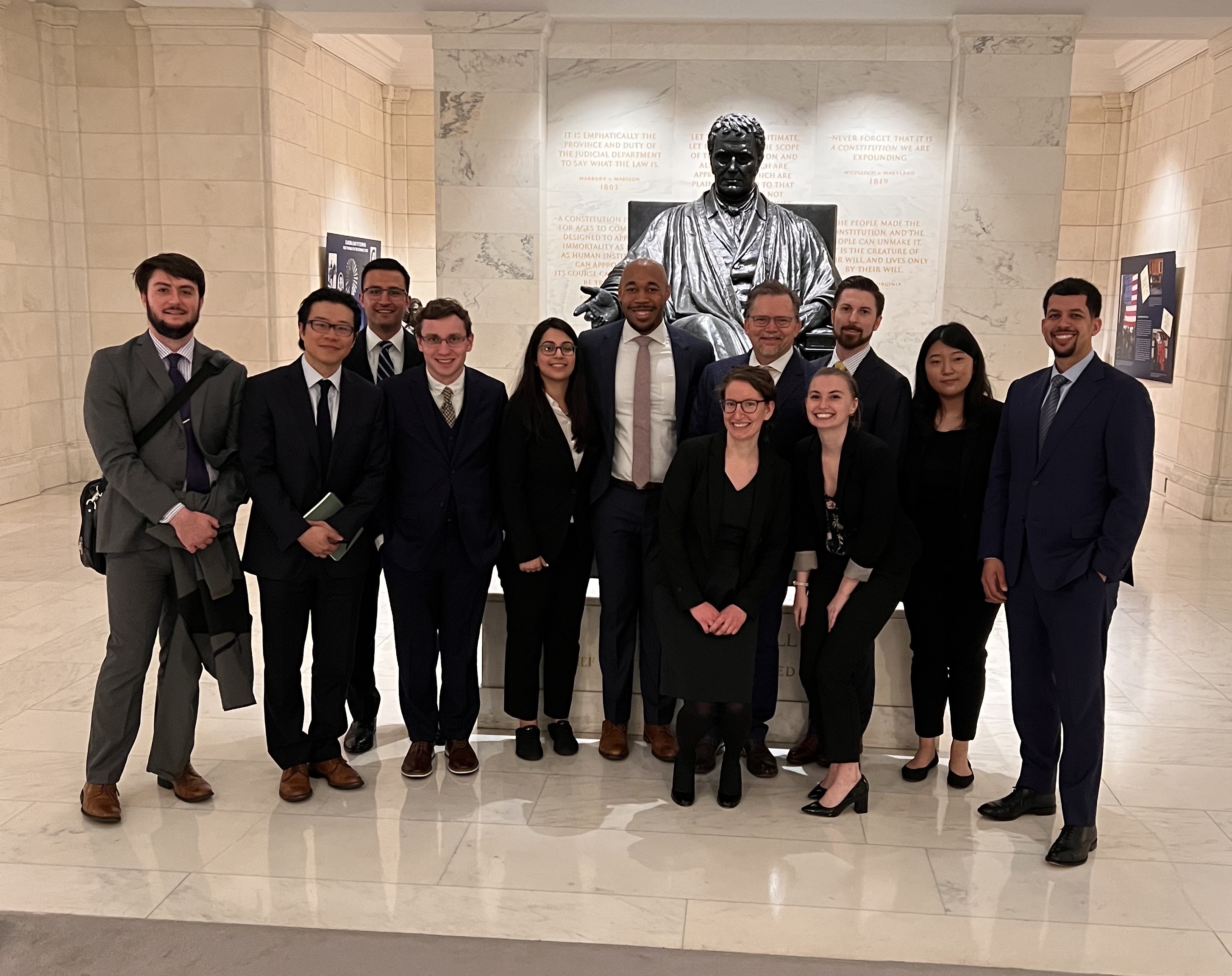
“One of the best classes I’ve taken at BC Law.” This is an almost guaranteed statement from any student who has taken The Supreme Court Experience with Professor Kent Greenfield. If you have the opportunity, take the class! Even if you plan to forget litigation and focus on a corporate practice (like me), take the class! Even if you are a 3L and don’t intend to “work too hard” next year, take the class!

Did I convince you already? You can apply now for Fall 2023 by filling out this form.

Continue reading

Students Respond to Dobbs V. Jackson: Part Two

Student organizations have issued two joint letters in response to the recent leaked SCOTUS draft opinion. BC Law Impact has agreed to publish these letters in the interest of continuing a respectful dialogue within our community on this important issue. The following letter was issued by the organizations listed below.


By now you have probably seen the student statement regarding the Dobbs v. Jackson Women’s Health Organization, Inc. draft opinion from the Supreme Court. Unfortunately, this statement may create the impression that it represents our entire community. It does not.

While we understand many students feel strongly opposed to the draft opinion, we are also aware that pro-life students are just as much a part of the BC Law community. BC Law has always been a place where people with different ideas and beliefs can learn from and befriend one another.

We hope it is made clear that not all student leaders agree to the statement put out earlier today through the Law Student Association email account. As the most recent Diversity and Inclusion Statement notes, we acknowledge and welcome a range of viewpoints. Those with principled disagreements can still share the same community. Diversity of thought makes our community strong. We are confident that tradition will continue.

The draft opinion represents a major victory for our democracy. In 1973, the Supreme Court ended debate on the contentious issue of abortion. They hoped then, and later in Planned Parenthood v. Casey, that the issue would be settled. Despite perhaps good intentions, they were wrong. Abortion raises significant moral questions about a woman’s liberty, medical care, and the rights of the unborn. Since abortion was erroneously crystallized as a constitutional right, court battles have led jurists with no expertise to attempt to determine when life begins. Many believe that this question should be answered by us and our representatives, not the judiciary.

As law students, we know that the courts are powerful. When properly constrained, regular people are free to decide through their elected officials what values our law will reflect. We encourage all students to respectfully speak their minds on this issue. We applaud the effort to return this important topic to the people. We agree with our classmates that this dispute is far from over. Should the draft opinion be adopted by the Court, the debate would only just begin.

At BC Law, we sincerely hope that an exchange of different ideas and beliefs continues respectfully.

Signed,
BC Law Republicans
International Law Society

Students Respond to Dobbs v. Jackson: Part One

Student organizations have issued two joint letters in response to the recent leaked SCOTUS draft opinion. BC Law Impact has agreed to publish these letters in the interest of continuing a respectful dialogue within our community on this important issue. The following letter was issued by the organizations listed below.


By now you have heard of the Dobbs v. Jackson Women’s Health Organization, Inc. draft opinion leaked from the Supreme Court overturning the decisions in Roe v. Wade and Planned Parenthood v. Casey. The draft, written by Justice Alito, sets the stage for millions of Americans to lose their constitutionally protected right to a legal and safe abortion. 

While the authenticity of the draft was confirmed, we still do not know whether this is the Court’s final opinion. Today, abortion is still legal in all 50 states. But if this is the Court’s opinion, it soon will not be. States have already been empowered to pass increasingly draconian and restrictive abortion bans in recent years. Twelve states have trigger bans that immediately go into effect if Roe and Casey fall. Some states have pre-existing anti-abortion laws still on the books. In all, abortion will be protected in less than half of U.S. states and territories if Roe and Casey are overturned. We also acknowledge that while Roe and Casey reified the right to abortion, access to this fundamental reproductive freedom is not accessible for all, especially low-income women of color, trans men, other pregnant people, and those living at the intersection of marginalized identities. Furthermore, coinciding with the uptick in laws modeled after Texas’ S.B.8, this decision opens the door to surveillance and criminalization of pregnant people and those who perform abortions.  In a criminal judicial system that has been built on systemic oppression, it is no surprise that the increased targeting of pregnant people will disproportionately criminalize Black, Brown and Indigenous people. Those who are disenfranchised in this country will experience the greatest impact from this decision. 

We also recognize that many people may fear the broader implications of this decision and what precedents may be overturned next. While people throw out the names of cases like Lawrence and Obergefell to illustrate the potential catastrophic consequences of the Court’s actions in Dobbs, the fear that many people have that their liberties and identities are threatened is very real. Even without the decision in Dobbs, the rights of LGBTQ youth and adults have been in peril–from “Don’t Say Gay,” to attacks on transgender youth, the community has a lot to fear. The Court’s decision–which will also inevitably impact trans pregnant people seeking healthcare at a higher rate– only adds to that. We stand in solidarity with our LGBTQ communities and communities of color.

As student leaders we realize the role we have to offer comfort, information, and solidarity in moments such as these. We want to acknowledge the deep sadness, anger, and fear many students–particularly those assigned female at birth–are feeling right now. We recognize that this comes at a very stressful time in the semester, making the news even harder to stomach. We will aim to create spaces to understand the intellectual and emotional implications in the fall and over the summer. Your community at BC Law is here to support you. 

As law students, we know the law is malleable, ever-changing, and a way to influence society. We encourage those of you who feel disempowered or frustrated by these decisions to use your power as a law student to effectuate changes you want to see. Whether that means donating to abortion funds or legal defense funds, explaining doctrine to others, engaging in legislative advocacy in your home state or at the federal level, or even joining the profession as a reproductive rights/justice advocate, this fight is far from over. 

Signed, 

American Constitution Society 
If/When/How: Law Students for Reproductive Justice
Law Students Association (LSA)
Asian Pacific American Law Students Association (APALSA)
Black Law Students Association (BLSA)
Boston College Law Democrats
Disability Law Students Association
Health Law Society
Holocaust/Human Rights Project
Immigration Law Group
Lambda Law Students Association 
Latin American Law Students Association (LALSA)
Middle Eastern Law Students Association (MELSA)
Public Interest Law Foundation (PILF)
Women’s Law Center