At BC Law, your education does not only consist of the material you learn in your courses. BC hosts many conferences, functions, presentations, and discussions on just about every subject you can think of, from panels put on by professors addressing recent political actions to all-day events sponsored by BC’s journals and the Rappaport Center for Law and Public Policy. Recently, the Rappaport Center sponsored an all-day conference on criminal justice reform in Massachusetts that was open to both students and practitioners. There were three panels as well as a keynote address by Chief Justice Ralph D. Gants of the Massachusetts Supreme Judicial Court.
perspectives
Through the Eyes of a Child
If you are ever looking for a brutally honest opinion of yourself, swallow your pride and ask a five year old.
In the years I spent working with kids at a community non-profit, I had the pleasure of hearing such gems as, “Miss Morgan, your tummy looks like my mommy’s when there’s a baby inside!” and “Did you know you look a lot less pretty when you wear your glasses?” Though some took these remarks seriously, one look at the sweet little faces from which the comments sprang forth never failed to make me laugh out loud. The children who attended these programs, often with the help of scholarships and sliding-scale payment plans, were typically filled with a joy and sense of innocence that made me absolutely love my job. All too often, however, these amusing little observations were juxtaposed with unfettered comments about living situations that revealed just how much these kids had been through in their short lives. I cannot forget the five-year-old who told me she wanted to kill herself because she missed her father so much, or the look of shame in an eleven-year-old’s eyes when his mother arrived to pick him up while high on drugs. I often felt frustrated by my inability to help these kids beyond passing the information along to DCF. I wanted so desperately to be able to advocate for these children in a way that went beyond simply telling someone higher up than me.
Our Alumni Association Network
I’m pleased to host today’s blog from Kenneth Sanchez ’03 and Dionna F. Shear ’14, the co-chairs of the Los Angeles chapter of the BC Law Alumni Association. Our alumni network is one of the strongest in the country, and I think their post gives you a sense of our alumni’s commitment to each other and to new generations of students.
Life after law school can get very busy, very fast. After three years of law school and the associated neurosis, stress, and countless nights of no sleep, you get to do it all over again. Life as a practicing attorney can be even more stressful when balancing the needs of your clients, meeting minimum billables, and trying to maintain some kind of social life outside of work.
Who has the time to do anything else? Who wants to mingle with other lawyers after spending the entire day dealing with them? What could my law school possibly have to offer me beyond a legal education? The answer to all that is very simple. Alumni should be involved with their alumni association because besides your education, the most valuable thing your law school offers you—and the students who come after you—is a network.
Humans of BC Law: Professor Martin O’Malley
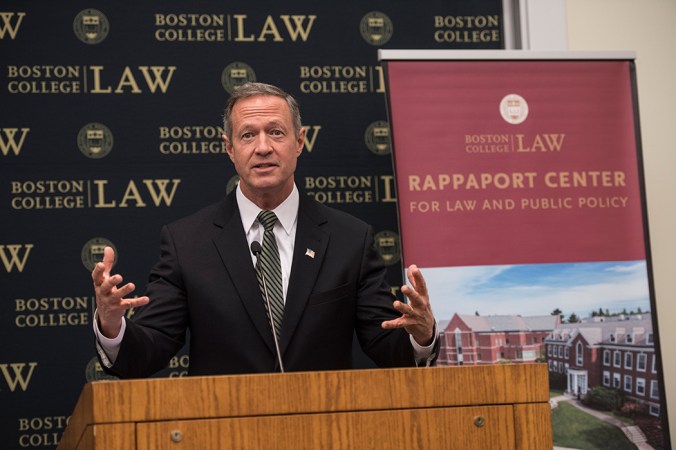
“I think you’re going to see more young people running for office for the first time in these next elections than ran for the first time inspired by President Obama’s success. … In my experience on the presidential stage — a tour that was shorter than I would have hoped — it seemed that anger and fear were the animating emotions of the entire election.
Why I Am Pursuing a Career in Law
She was only seventeen when she realized she was pregnant. Having grown up in a predominantly white town in Ohio, she knew better than to bear a black man’s child, especially at that age. An adopted child herself, she decided someone else could provide her son a better life than a struggling high school student could. But my mother suddenly changed her mind seconds after holding me; by and large, my life’s greatest blessing. The struggles that would confront her may not have been clear at the moment, but she was willing to sacrifice plenty: forgoing college dreams, working multiple low wage jobs to put food on the table, being shunned by family for the color of her child’s skin, and most of all, being forced to do so alone. It was the nights that I awoke to her muffled sobs, seeing her still dressed in dirty waitressing clothes, that impacted me the most. I learned early on in life that the cards may not always be in your favor and that some people have to work harder to succeed. Yet by witnessing her struggle, I ultimately learned the value of resiliency and hard work. My mother’s perseverance instilled an insatiable hunger and an unrelenting drive, which ultimately would guide me through life. Continue reading
Governor O’Malley at BC Law: Restoring Integrity to Our Democracy
Governor Martin O’Malley may have taken a step back from the national stage to reflect and teach in suburban Newton, Massachusetts, but he is certainly not shying away from the issues at the heart of current American politics. In a talk entitled “Restoring Integrity to Our Democracy” at Boston College Law School on Tuesday, Gov. O’Malley contemplated the conditions that resulted in President Donald Trump’s election and urged action on a series of fronts in order to protect and revitalize our democratic system of government.
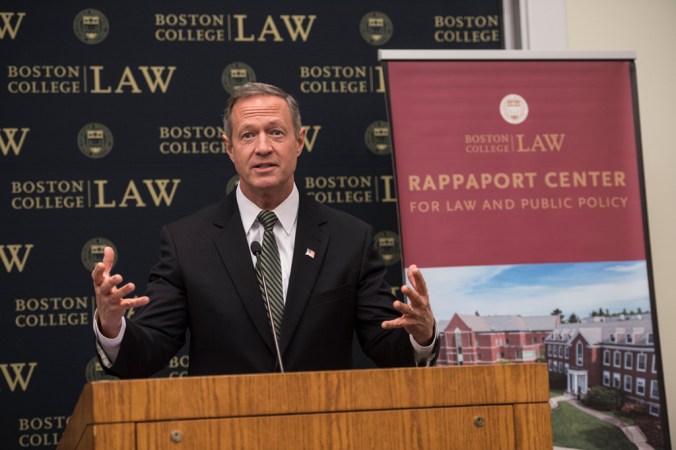
The former Governor of Maryland and Mayor of Baltimore, who just last year shared a debate stage with Democratic Party candidates Hillary Clinton and Bernie Sanders, struck an ominous tone at the outset about the current state of the country. He warned of the dangers of the President’s ideology, which he called “Trumpism,” before rejecting Pope Francis’ recent suggestion that we should “wait and see” what President Trump does before judging him. “Our political institutions are in a state of crisis,” he said. “Now we must ask what each of us will do.”
A March on D.C. in Support of Pluralism
Even though I was not able to attend the Women’s March in D.C., I’ve been able to live vicariously through the experiences of several classmates, like my friend Molly McGrath. Molly is a 2L at Boston College Law School and originally from western New York. At BC, she is involved in LAMBDA and the Environmental Affairs Law Review. Although she doesn’t know exactly where her legal career will take her, she is grateful to attend an institution like BC Law and use its resources to navigate a rapidly changing legal and political climate.
A classmate and I sat in a law library study room several days after the election. We’d originally reserved the room to cram for our Admin Law final, but found ourselves brainstorming ways to act with more intention and become more politically involved. My friend agreed to stop buying clothes online from retailers with supply chains reaching deep into the third world. I decided to schedule more time to read about the origins of the social justice movement. We both agreed to attend the Women’s March on Washington.
Why It’s Okay for You to Ask Me About My Hair
No, really, this isn’t a trap. It’s okay.
I got to thinking about this the other day at my bartending job when a customer made a comment on my hair.
She was an older white woman (we’ll call her Jane) sitting with her husband. Since we had all of ten customers in the bar at the time, I’d been shooting the breeze and answering questions from Jane and her husband, when Jane smiled and said, “Your hair is so gorgeous. How do you do it?”
Let’s begin with this: I have a lot of hair. Both the hair that grows out of my scalp and the hair that is only mine thanks to capitalism and the laws of possession.
Teach, Work, Love: Professor Hillinger on BC Law
Take a few minutes to watch the following video profiling Professor Ingrid Hillinger, who is one of BC Law’s most respected professors . She is known for her demanding but rewarding teaching style and her tireless devotion to members of the BC Law community. One of her students told me she has, at times, sent emails in the wee hours of the morning, and that she is rumored to be the one who unlocks the school in the mornings.
Her reputation isn’t restricted to our campus, either—she was named one of the “26 best law teachers in the country” in the book What the Best Law Teachers Do (Schwartz, 2013). See a BC Law Magazine article here about what makes her so good.
I have not had the privilege of taking a class with Professor Hillinger, so I turned to two of my classmates for their perspectives:
Taking a Leave
When I started law school, I didn’t think it would go like this. I thought the hardest thing I would have to face would be the workload, and my commute. The only thing I feared was my anxiety taking over, and making it hard for me to get by. I was scared, but excited, at the prospect of three years doing something I had been working so hard and so long to do.
When I started law school I never thought I would miss almost all of my 1L spring to a chronic illness I had only just learned I have. I didn’t think I would have to postpone my finals to accommodate surgery to get better. I couldn’t imagine I would miss almost all of my 2L fall to that same illness, after the first surgery didn’t work. And never, in all my wildest fears did I think I would be taking the spring semester of my 2L year off to have another surgery; my second in less than a year.
But here I am.
 BC Law: Impact