On Innocence, Factual and Moral

One of the first lessons taught in the year-long Boston College Innocence Clinic concerns the concept of “factual innocence.” It is closely related to the concept of “actual innocence,” though different jurisdictions may refer to one or the other, and the substance and application of those terms can vary. Regardless of which term is deployed, it’s a bit of a head-scratcher when clinic students learn that the legal concept of “actual innocence” entails its own discrete body of thought and doctrine within criminal law. Doesn’t the determination of actual innocence suffuse the entire criminal-legal process?

It turns out it does not, and factual innocence is largely a claim raised in the post-conviction setting to overturn a wrongful conviction. That claim often finds little legal purchase. In Herrera v. Collins, for instance, the Supreme Court held that a claim of actual innocence does not entitle a person to federal habeas corpus relief under the 8th Amendment’s proscription of cruel and unusual punishment. Constitutionally and procedurally intact convictions can remain undisturbed by the truth. In Herrera’s case, a capital case, the Court ruled it was not cruel and unusual to execute an innocent man. That kind of antiseptic, procedural logic is one striking example of how the banality of evil manifests itself within the criminal legal system.

Continue reading
Innocence Program: Inspiring the Fight for Justice

Over the decade and a half since its start, The Boston College Innocence Program has amassed an astonishing reputation for its work in innocence advocacy and wrongful convictions. Bolstering an impressive record, BCIP both represents innocent individuals and works with policymakers regarding legislative reform, quite literally changing lives every step of the way.

This year in particular, BCIP has secured an impressive amount of exonerations and releases, using new evidence and instances of misconduct, with three major victories in 2020 alone:

Continue reading

Remembering Bobby Joe Leaster: Saving Boston’s Youth

Guest blogger Rita Muse ’15 comes from a line of BC Law graduates. Her grandmother, Judge Mary Beatty Muse, graduated in 1950, her aunt, Patricia Muse, in 1990, and her cousin, Julie Muse-Fisher, in 2005. Her uncle, Christopher Muse, though not a BC Law grad, has been a longtime adjunct professor at the Law School. He and Rita’s grandfather, Robert Muse  were instrumental in the release of the wrongly convicted Bobby Joe Leaster. Their engagement with Leaster in the 1980s had a lasting impact on the Muse family, including on Rita, who, as a law student, helped to free another innocent man.  


Bobby Joe Leaster: A Remembrance
By Rita Miuse ’15

When Bobby Joe Leaster spoke to BC Law students and faculties, his story was the same but his message never got old; he was wrongfully convicted of murder and unjustly imprisoned for almost 16 years, but he dealt with injustice in his own profoundly special way. This past April 26, one of BC Law’s favorite guests and a beloved citizen of Boston, passed away from the severe burns he suffered in a home fire three weeks earlier.

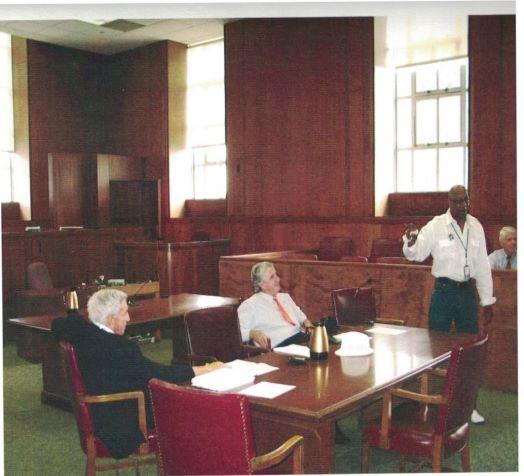
Bobby Joe Leaster, with his lawyers, Robert and Christopher Muse

Bobby Joe Leaster, with his lawyers, Robert and Christopher Muse, teaching Judicial Youth Corps students in the courthouse where he was convicted.

This is my remembrance of the person who motivated me as a student, inspired me as a lawyer, and became a friend of my family, two of whom, my grandfather Robert Muse and my uncle Christopher Muse, a longtime adjunct professor at BC Law, helped to free Bobby Joe.

Continue reading