Where Do We Go From Here? The Women’s March

Note: see our related post for a BC Law perspective on the march in Washington DC.

In the aftermath of Election Day, I experienced what can only be described as grief in its many defined stages. Like many others, I denied the reality of a Trump presidency, clinging to some false hope that this was all simply a nightmare. I was angry, constantly resisting the urge to lash out at those who seemingly did not grasp the gravity of the situation. My rational mind eliminated the possibility for bargaining before it even began, leaving me depressed and dejected in the face of the never-ending daily news cycles. I waited, almost hoping for the day when it would all be okay, the day when I would finally come to terms with the next four years, accepting the new administration in all of its inconceivability. But I simply could not reach the point of acceptance.
Continue reading

A March on D.C. in Support of Pluralism

Even though I was not able to attend the Women’s March in D.C., I’ve been able to live vicariously through the experiences of several classmates, like my friend Molly McGrath. Molly is a 2L at Boston College Law School and originally from western New York. At BC, she is involved in LAMBDA and the Environmental Affairs Law Review. Although she doesn’t know exactly where her legal career will take her, she is grateful to attend an institution like BC Law and use its resources to navigate a rapidly changing legal and political climate.


A classmate and I sat in a law library study room several days after the election. We’d originally reserved the room to cram for our Admin Law final, but  found ourselves brainstorming ways to act with more intention and become more politically involved. My friend agreed to stop buying clothes online from retailers with supply chains reaching deep into the third world. I decided to schedule more time to read about the origins of the social justice movement. We both agreed to attend the Women’s March on Washington.

Continue reading

On Privilege, Action, and Trump

On Tuesday night, I lay in bed refreshing the New York Times app and checking Twitter franticly. I voted for Hillary Clinton, and supported her from the first day of the primaries to the last day of the general; in fact I’d hoped that she would be running long before she announced it. When the push notification came into my phone naming Trump as president-elect, I cried.

The results of the election were gutting, for a number of reasons. After a campaign fueled by hatred and fear, Donald Trump’s presidency validated every anxiety I had felt during the general election—that there were more people willing to put the rights of others on the line to salvage their own privilege than there were people willing to work to correct the injustices in this country. We now know that Hillary won the popular vote, and while that is in and of itself reassuring, it does nothing to assuage my concerns about what a Trump presidency will mean for the safety of people of color, women, members of the LGBTQ community, disabled people, Muslims, or immigrants. Almost half the country voted for someone who admitted to sexually assaulting women, who called Mexicans rapists, who promised to ban Muslims, and who mocked a disabled person, and that is a stain on our history that will never come out.

Continue reading

Niece May For President

I am thrilled and honored to be hosting this guest blog today from 2L Mousa Al-Mosawy on the impact of this incredibly important election.

My niece, May, is a witty six-year-old girl who just entered the first grade of elementary at the American Community School in Jordan. Even though she lives in the Middle East, May is an American citizen. Usually, I get to see May on Skype or over her summer holiday when she comes to the United States. We talk about everything from her school activities to new Disney releases to questions about my disability and wheelchair. Watching a child grow and communicate, in different ways, is a true wonder. May is curious yet cautious, she opens topics by asking pointed questions and forms an opinion based on the responses. In our last Skype session, my sister, Nour, told me about a conversation she had with May. It went something like this:

Continue reading

Crime Documentaries: Are They Really Helping?

I’m happy to be able to host a guest blog today from first-year student Christina Sonageri.

Technology has changed the way we do a lot of things—including the way we stream content. With the advent of platforms like Netflix, HBO Go, Amazon Prime and Hulu, society has access to movies and shows at the click of a button. The change in how we are able to watch has helped to facilitate a more efficient way for producers and writers to share their stories.

One genre that I think has really flourished as a result is the crime documentary. Now, even when I hear the word “documentary,” my mind begins to swirl with mug shots of Steven Avery, the subject of Netflix’s Making a Murderer series, and images of the countless other subjects whose faces define the genre. Every time a new crime story is released, it seems it’s the only thing that anyone can talk about.

However, growing up the daughter of two lawyers initially made me skeptical of anyone who was trying to fit a whole case into just a few hours of television or film. So I decided to sit down and explore whether these types of documentaries are helpful or detrimental to the people involved in the crime—and what their impact on society’s faith in the justice system might be.

Continue reading

History in the Making

I’m very excited to host a guest blog from a go-getter BC Law 1L, Brianna Marshall. She is originally from central Pennsylvania, and graduated from Bucknell University in 2015 with a degree in Animal Behavior and a French minor. During her gap year, Brianna lived in New York City, working for several nonprofits dedicated to food policy and global hunger. At BC Law, Brianna is now a 1L Section Representative for the Art Law Society and a Staff Writer for the Intellectual Property and Technology Forum (IPTF) Journal. Have questions about life as a 1L? Contact Brianna at brianna.marshall@bc.edu


Election season is fully upon us and, as expected, BC Law is abuzz with many of the same tensions, fears, and frustrations felt throughout the country given the current political climate. Continue reading

Regulation and Moderation: Lessons from the Subprime Disaster

I’m James Barasch, a 2L and I’m pleased to writing for Impact again this year! I used to run a book and movie review blog during my time at Tufts University, and I thought I’d continue that tradition here at BC Law.

The great financial crisis of 2007-2009 was an economic Pearl Harbor for many of us at BC Law School. As the Crash of 1929 and the Stagflation of the ‘70s did in previous generations, the failure and instability of many seemingly unbreakable banks, financial institutions, and large corporations caused large ripples of financial insecurity and uncertainty that are taking years to work through the economy.

Continue reading

Toward Inclusivity and Cultural Competence

Hi everyone and happy summer! I am very pleased to be able to host a guest blog today from the BC Law Alumni Board member Ingrid Schroffner, Assistant General Counsel at the Executive Office of Health and Human Services.


I am passionate about—and feel fortunate to be able to work on—diversity and unconscious bias issues at the Executive Office of Health and Human Services (EOHHS). My cross-cultural upbringing and my experience as an Asian-American lawyer contribute to my interest in this area.

My maternal grandfather immigrated from Okinawa to Hawaii in the first part of the 20th century to work in the sugarcane fields. I attended Japanese school when I was a child, and my household was filled with Japanese culture.

I also have a cross-cultural, East-West perspective. My father is a first-generation immigrant from Salzburg, Austria. I learned German from my father (and later, in school) and spent a summer living and working in Austria with my relatives. None of my grandparents spoke English. These two diverse heritages comprise my background.

Continue reading

My Summer with a Judge

What’s it like to be a judge?

It’s my sixth week of working for Judge Dineen Riviezzo of the Kings County (Brooklyn) Supreme Court. Judge Riviezzo hears felony cases and Article 10 civil confinement cases. Also, every Friday, she’s in charge of the juvenile offender part, where she hears cases involving 14, 15, and 16-year-olds who would normally be heard in Family Court, but because they commit certain serious crimes, are heard in Supreme Court (but are often afforded youthful offender treatment).

FullSizeRender

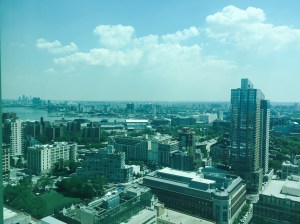
View of Brooklyn from the Judge’s chambers

So far, I can say that being a judge requires three major qualities.

First, it requires patience. Whether it’s dealing with an attorney’s mistake, sorting out a disagreement between the parties, or waiting for a defendant to be produced or parties to show up, I’ve learned that for judges, every day is a test of patience. Continue reading