During my 1L spring semester, an email advertising Academic Success Program Director Nina Farber’s Productivity Labs caught my attention. Thinking to myself, “who wouldn’t want to be more productive,” I filled out the sheet and awaited the results. Thankfully, I was accepted, and over the course of the next few weeks, I met once a week with Nina, alongside several other students, learning strategies catered towards studying, meditating, and test taking. One lesson of the program that has remained in my arsenal of tactics against unproductivity is breathing, particularly breathwork.
Breathwork consists of various exercises, techniques, and therapies that regulate the way one breathes. It is particularly practiced in order to promote mental, emotional, and physical health. In recent years, interest from the public in breathwork has actually been on the rise, and it has been shown to have therapeutic potential to improve mental health. Breathing is a primarily automatic process that works without conscious intervention. Due to the unconscious nature of breathing, I fear that we all may have grown to be unappreciative for this basic but essential function that keeps us alive.
In contrast to our modern literal view of one’s breath, various cultures throughout history have found that the air and one’s breath have enough importance to be viewed as synonymous to one’s own spirit/soul. Pre-Socratic Greek Philosopher, Anaximenes of Miletus (c. 585-528 B.C.E.), is best known for his doctrine that air is the source of all things. He proposed a theory that air was the First Cause from which all else comes and considered “air” as an extension of the breath.
Let’s play a quick game of etymology to assist in our understanding of the importance of breathing.
The modern English term, spirituality, refers to spirit and comes from the Latin word spiritualitas. Spiritualitas springs from the noun spiritus which means breath of life. The semantic root of spiritus is the word spirare which means to breathe, to blow, and to live.
Coincidentally, stemming from the same semantic root, spirare, is the Latin word, inspirare, which means “to breathe or blow into.” It combines in- (“in”) and spirare (“to breathe”), originally implying to breathe life into someone. Our earliest written English uses of inspire and its counterpart inspiration, give it the figurative meaning “to influence, move, or guide (as to speech or action) through divine or supernatural agency or power.”
This act of breathing spirit into something is a myth that presents itself across various cultures and religions across the world. In Western Jewish and Christian traditions, the Holy Spirit is viewed as the breath of God. The Hebrew term ruach, used in the Book of Genesis creation story, indicates the spirit, wind, and breath of God. Ruach provides life to mankind when “the Lord God formed a man from the dust of the ground, and breathed into his nostrils the breath of life, and the man became a living being” (Gen. 2:7).
In the Hindu tradition, whenever Maha Vishnu exhales, innumerable universes flow forth from the pores of his transcendental body, and when he inhales, all creation returns to him. For the Khoisan peoples of southern Africa, the wind is viewed as the breath of God that gives life. Other world religions and philosophies, such as Islam, Buddhism, and Taoism also recognize the breath as first human life sine qua non. Similarly, within Greek mythology, Prometheus shaped man out of mud, and Athena breathed life into his clay figure. It seems that despite religion, ethnicity, or culture; we are all connected through our first inhalation of air at birth.
I recently had a conversation with my mother and I mentioned that I was tired. She responded that I should be grateful for my current circumstance in life. As law students we are all aspiring lawyers. We are striving and making ourselves breathless in the pursuit of goals that we have decided for ourselves long ago. The word aspire comes from the Latin word aspirare. It consists of a prefix of ad “to/toward” and spirare “to breathe.” The idea expressed here is that when a person is aspiring, they are “panting with desire.” So, it makes sense that we experience fatigue as we move forward along our respective journeys dictated by desire. I guess it is true, mother is always right.
Despite tiredness being a common experience among law students, it should still be addressed, first, of course, with some sleep, but secondly, with well intentioned breathing. A good inhalation of air can do wonders. Funny enough, inhalation and inspiration are direct synonyms of one another. With just taking a breath, you can gain the inspiration that you lack in the present moment to study, complete your assignment, or apply to a job. However, this breath must be taken with full use of body, mind, and spirit.
Below you will find a graphic of the Box breathing technique, graciously provided to me by Nina Farber. While you complete this box breathing method (preferably outside), make sure to close your eyes, think about how grateful you are for your present circumstance in life, as well as envision yourself beyond it.
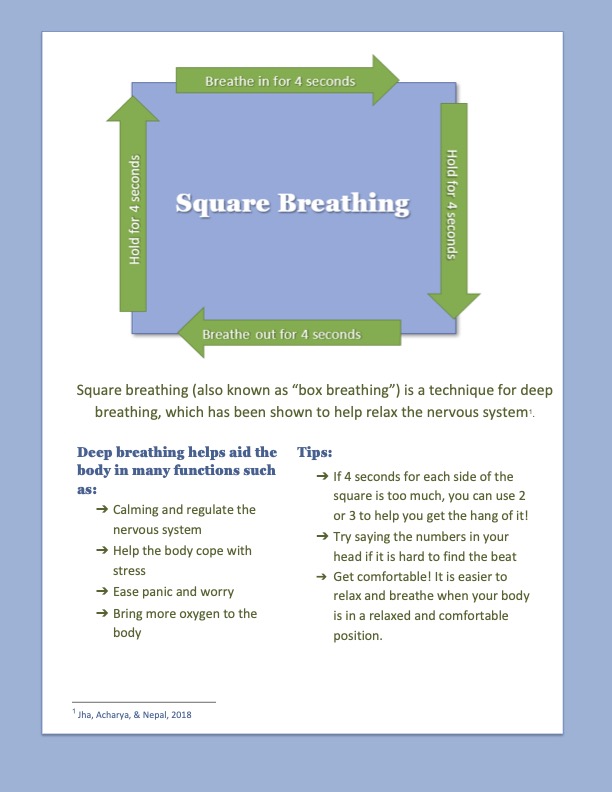
As mentioned earlier, breath, air, and spirit are all intertwined. After completing this breathing exercise, you should be in high spirits, particularly feeling confident about your present self and future.
In essence, I’m grateful to now understand that with each breath I take, I am filled with the Holy Spirit and move nearer to Yeshua. This perspective has even birthed a newfound appreciation for the cold. Specifically, the recent 20-degree high wind gusts that we have been facing, despite being halfway through March. Although harsh, this cold air is still air, and thankfully it surrounds us at all times. The air around us provides a comforting reminder that God is always present. Sometimes, all we have to do is be still and breathe in order to acknowledge Him.
Staniel Brutis is a third-year student at BC Law. Contact him at brutis@bc.edu.
 BC Law: Impact