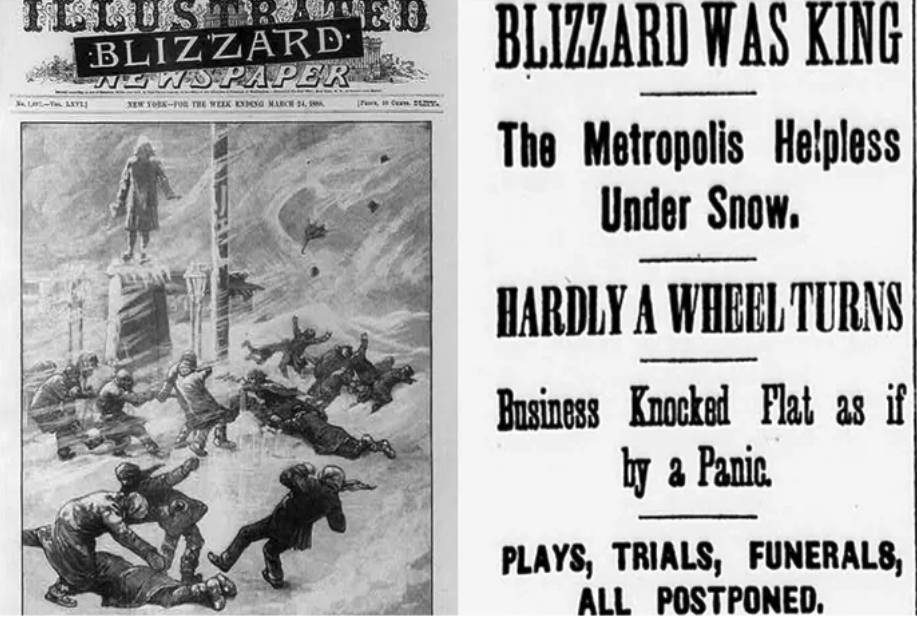
This weekend’s bitter cold reminded me of a three-day storm long in the past that makes our modern Nor’easters look positively quaint. On March 11-14, 1888, the “Great White Hurricane” buried the Northeast under 50 inches of snow coupled with 85 mph winds. According to contemporary account in the New York Evening Sun, “It came in whirls, it descended in layers, it shot along in great blocks, it rose and fell and corkscrewed and zigzagged and played merry havoc with everything it could swing or batter or bang or carry away.”
In New York, a woman watched the blizzard destroy the city from her apartment window. She “saw a man for one and a half hours trying to cross 96th Street. We watched him start, get quarter way across and then be flung back against the building on the corner. The last time he tried it, he was caught up in a whirl of snow and disappeared from our view. The next morning seven horses, policemen and his brother charged the drift, and his body was kicked out of the drift.”
While trapped in his hotel, Mark Twain cursed the storm that prevented his wife from joining him. “A mere simple request to you to stay at home would have been entirely sufficient, but no, that is not big enough, picturesque enough—a blizzard’s the idea; pour down all the snow in stock, turn loose all the winds, bring a whole continent to a stand-still.”
At the very least, New England was at a stand still. Merely walking the street was a life-threatening endeavor due to the chances of slipping and falling into a deep snow bank. Former US Senator Roscoe Conkling collapsed during the blizzard and died shortly afterward due to complications from pneumonia. Only 30 out of the 1,000 employees at the New York Stock Exchange showed up for work. Many New Yorkers camped out in hotel lobbies and waited for the blizzard to pass.
Lyman Worden, a farmhand in Barre Plains, Massachusetts, recounted his misfortune of dealing with the storm firsthand. On the 14th, he wrote: “Shovel snow ½ day. Snow sticks to shovel and acts mean. Some big drifts 6 or 7 ft. deep.” The next day: “Shovel snow. Road broke from Hamilton’s to town. No pay for shoveling.”
All those who experienced the blizzard knew they were living through a significant life-altering event, but some tried their best to keep life as usual. Theodore Roosevelt trudged through the raging blizzard to keep an appointment with the librarian of the New-York Historical Society. Upon arrival, he discovered the librarian—far less hardy and considerably more reasonable—had stayed home. Roosevelt walked back and sent a short note: “I presume the blizzard kept you at home.”
As we fight our own weatherly woes, it can be warming to see that humanity has suffered and survived much worse. It is hard to fathom fighting fifty inches of snow and 85 mile-per-hour winds with 1888 technology. Nevertheless, what we cannot fathom is what they endured and surpassed.
Alex Mostaghimi is a third-year student at BC Law. Contact him at mostagha@bc.edu.
 BC Law: Impact