After my last exam, I took my usual walk home down Commonwealth Avenue, past Boston College’s main campus toward the quiet rows of Evergreen Cemetery. Winter had settled in, that strange season in Boston when night seems to arrive by three in the afternoon. The air had turned sharp, the kind of cold that still surprises a Floridian like myself, no matter how many winters I spend here. Out of the corner of my eye, a tall stone building caught the light of the moon and stood illuminated in the distance. I recognized it as Boston College’s McMullen Museum.
At that moment I remembered the old saying that curiosity kills the cat. Maybe it does. But I’m no cat. I’m a man, and curiosity has never killed a man worth remembering. So I stopped in my tracks, pulled out my phone, and looked up online whether they had any exhibitions open. When I saw that a new exhibit on Medieval and Renaissance art was on display, I decided to take a detour.
When I arrived at the museum, the galleries were nearly empty—quiet except for the low murmur of a small tour group of women who welcomed me to join them. Together we moved from piece to piece, talking about history, religious symbolism, and the strange, persistent emotions these centuries-old paintings could still summon. The exhibition closed on December 7, but in case you missed it, I’ve gathered a few photos of my favorite works to share here.
Some background into the era was offered by the inscription upon the wall at the entrance of the exhibition. The closing centuries of the Middle Ages in Europe brought profound transformations to the art of painting. New materials and techniques expanded the painter’s vocabulary, and evolving systems of patronage reshaped how art was made, valued, and attributed. Ideas of authorship and authenticity shifted alongside wider cultural debates, creating distinctions between “Medieval” and “Renaissance” that later generations would struggle to sustain.
Curated by John Landowne and Stephanie C. Leone, specialists in the Medieval and Renaissance periods, the exhibition draws from the century-old Frascione Collection of Florence. Each painting bears their initials, small marks of differing interpretation that invite the viewer to move between scholarly voices. Together, the works form a conversation on how the line between eras is never fixed, but constantly redrawn in the act of looking.
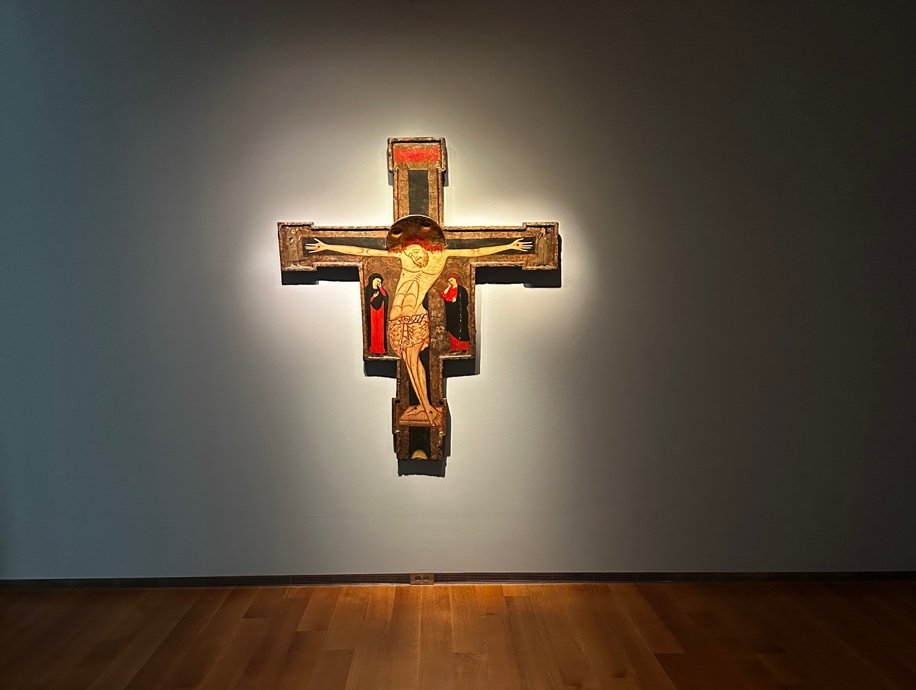
Umbria or Marche
Croce dipinta, late 13th century
Tempera, gold, and silver on panel
This painted crucifix, or croce dipinta once stood atop a choir screen, or tramezzo, dividing clergy from congregation while providing a visual focus for devotion. Aligned with the altar but facing the people, it served as a painted substitute for Christ’s Eucharistic presence. Christ’s pale, gleaming body seems to rise from the panel, his form deliberately fragmented, especially in the schematic treatment of the abdomen. At his sides stand St. Clare, canonized in 1255, to the left of Christ’s body, and St. Francis of Assisi, canonized in 1228, to the right. A young St. John and the Virgin Mary flank his outstretched hands. Their presence ties the work to early Franciscan spirituality and its focus on the humanity and suffering of Christ.
The image reflects late medieval concern over Christ’s suffering and his presence in the Eucharist, rooted in the Christus patiens tradition. The original blue of the cross, now faded to black, would have carried theological weight beyond simple decoration. In the Medieval and Byzantine tradition the shift from purple or gold to blue in Christ’s garments signified a move away from imperial connotations toward a color rich with meanings of divine humanity, kenosis, and the heavenly realm. The pigment’s source, lapis lazuli, was mined in remote Afghan mountains and traded across continents, so rare and costly that, pound for pound, it was often more valuable than gold. Its deep, luminous hue carried both the mystery of the sky and the tenderness of incarnation. Thus, making its use in devotional art not just aesthetic, but an act of reverence worthy of the divine.
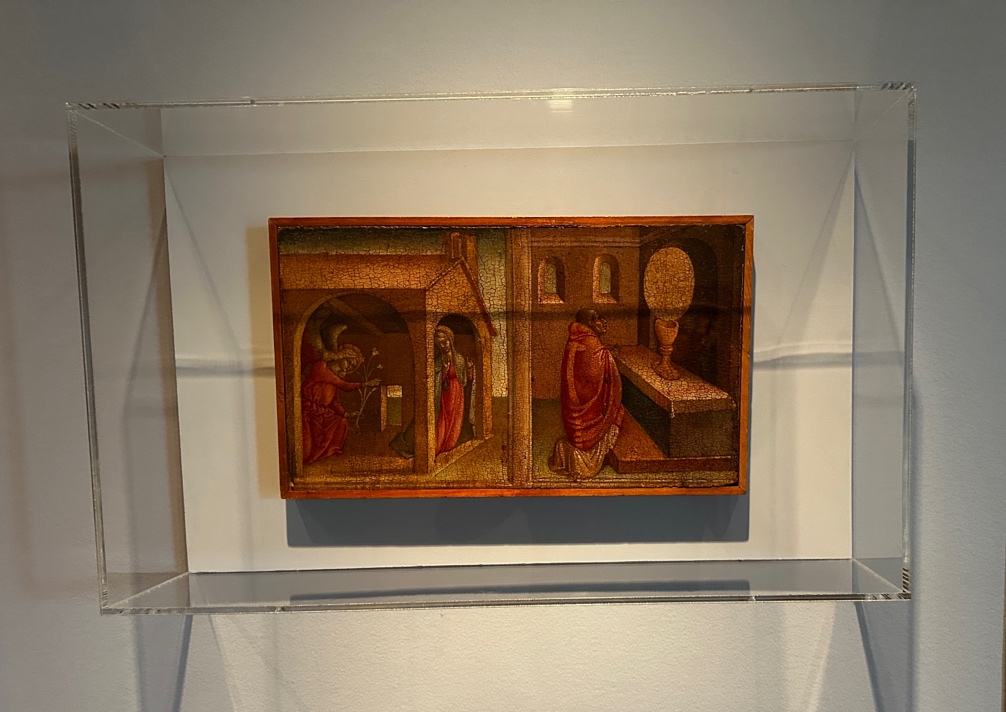
Ludovico Urbani (1490-93)
Annunciation and the Adoration of the Eucharist, late 15th century
Tempera on panel
This composition is organized like a perspective box divided into two narrative scenes. On the left is the Annunciation, where the Angel Gabriel unexpectedly tells the Virgin Mary that she will miraculously conceive the Son of God. On the right, a high-ranking ecclesiastical figure venerates a colossal Eucharistic host, marked by a faded cross and hovering above a chalice like an object set apart for adoration. The oversized host gives the abstract white wafer a near-human presence, highlighting its role as the body of Christ in late medieval devotion.
The Annunciation signifies the Incarnation, the moment when the immaterial Word became flesh in Mary’s womb. Opposite it, the consecrated host stands as the ultimate material proof of that event, illustrating the theological logic that made the Eucharist the central rationale for image-making in Medieval Christianity. The panel is attributed to Ludovico Urbani, a leading painter in the region of Marche, Italy. It was originally part of a predella at the base of an altarpiece but has since been cropped and separated from its larger ensemble, a common practice among early art dealers.
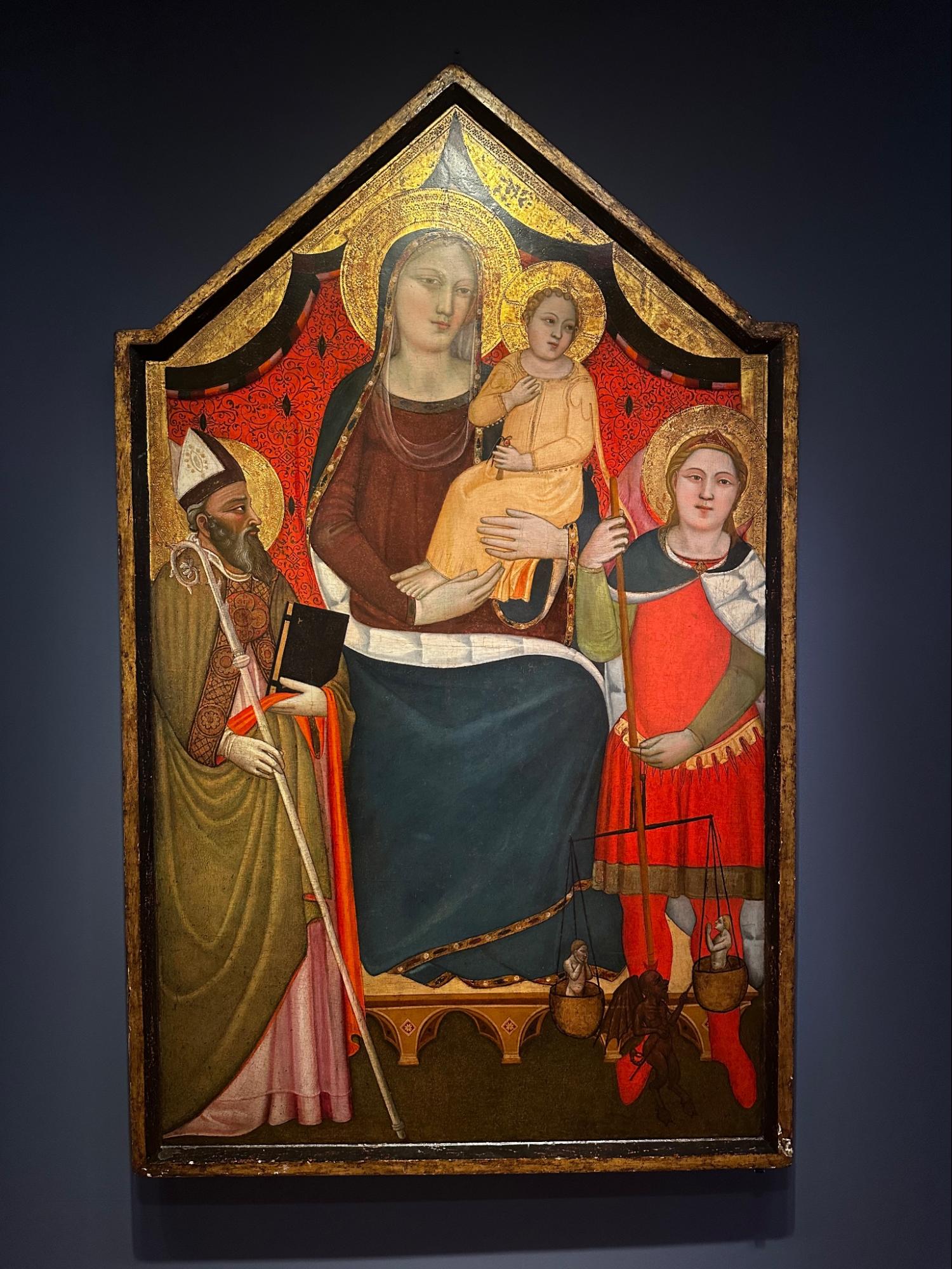
Master of Barberino
Enthroned Madonna and Child with Bishop-Saint and Saint
Michael the Archangel, ca. 1356
Tempera and gold on panel
The Madonna and Child occupy the center of this composition, their prominence signaled by their larger scale and elevated placement at the apex of the painting’s pyramidal structure. To the left stands a bishop-saint, distinguished by his mitre, crozier, and the book in his hand. On the right, Saint Michael the Archangel holds a spear and a pair of scales, weighing souls while a demon waits below. His steady gaze meets that of the viewer, a reminder of divine judgment and the fate awaiting every soul.
The halo rings behind the heads of the Madonna, Child, and saints serve as visible markers of sanctity and divine illumination, part of a long iconographic tradition in which circular bands of gold symbolize holiness and the radiance of heavenly light. Behind them, the richly ornamented cloth of honor shimmers in patterned gold created through sgraffito, a technique in which surface paint is scratched away to reveal gilding beneath.
Art historians attribute the panel to the Master of Barberino, an anonymous Florentine painter named for a dispersed polyptych linked to this work. Such provisional designations, known as Nonamen (from the German “names of necessity”), arose within the connoisseurial art market as a way to identify otherwise anonymous masters. The panel likely formed part of a predella at the base of an altarpiece before being separated from its ensemble—a fate shared by many medieval works as they entered private collections.
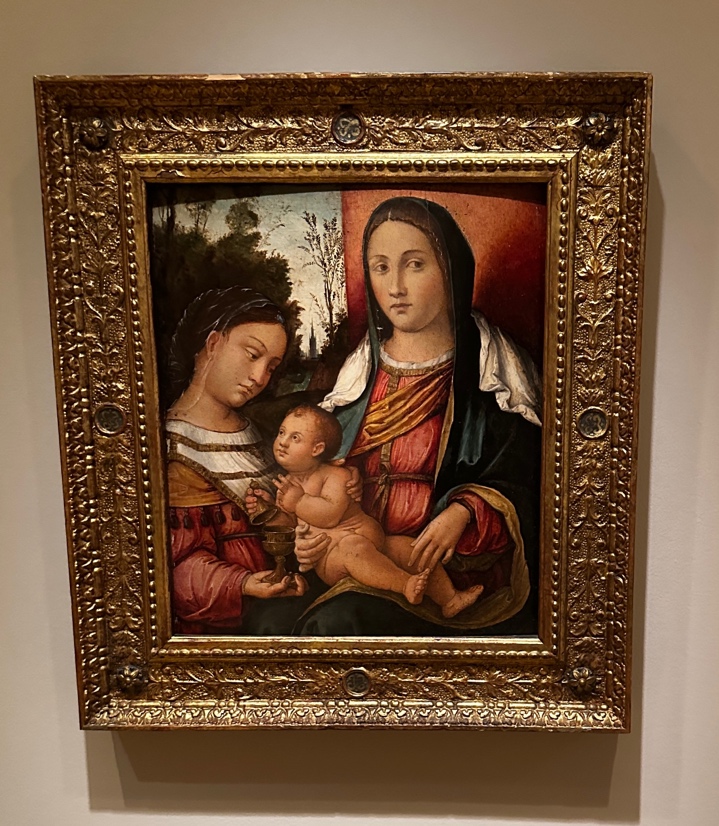
Attributed to Bernardino di Bosio Zaganelli
(Bernardino da Cotignola) (ca.1470 – 1510)
Madonna and Child with Mary Magdalene, ca. 1500
Oil on panel
This tender composition quietly foretells the events of the Passion. The infant Christ, still nestled on his mother’s lap, reaches forward toward St. Mary Magdalene. In her hand is the jar of oil she will use to anoint Christ’s body upon his death. The oversized jar draws the eye, and the scent-centered association between the child and his future suffering is unmistakable. Yet Christ does not recoil from his fate. In a playful gesture he grasps the jar with one hand and, with the other, seems to offer an oil-dipped blessing. The oil in the vessel is chrism, a perfumed sacramental oil associated with anointing and blessing. The attention given to the chrism here emphasizes Christ’s identity as “the anointed one”. Jesus Christ, Son of God, Saviour, or in the Greek, Ἰησοῦς (Iesus) Χριστὸς (Christos) Θεοῦ (Theou) Υἱὸς (Huios) Σωτήρ (Soter), reflects this meaning. Jesus was recognized as “Christ,” which means “the anointed one” (ὁ χριστός).
The composition’s melancholic tone is heightened by the expression of the Virgin Mary. Deeply rooted in Catholic and Byzantine symbolism, the blue of the Virgin’s cloak represents both her purity and her heavenly nature. The color also signifies her royal status, as blue was traditionally reserved for imperial figures in Byzantine art. The red of her inner garment conveys love, passion, and devotion. These qualities are associated with motherhood and are embodied in Mary’s steadfast presence at the Crucifixion.
Her eyes cast in sorrowful anticipation of what lies ahead. Behind the figures, delicate drapery and careful modeling draw the viewer into a scene that is both intimate and profoundly symbolic.
This painting became a point of discussion among our tour group, as Mary Magdalene carries a controversial position in early Christian doctrine. In the canonical Gospels, she is remembered as a follower of Christ and the first witness to his resurrection. Yet in several early non-canonical texts, most notably the Gospel of Mary, preserved among the Nag Hammadi writings and translated in Marvin Meyer’s The Gnostic Gospels of Jesus, she appears as a visionary disciple whom Christ entrusts with hidden teachings about the soul’s ascent and spiritual liberation. In this account, Mary’s favored place among the apostles provokes resentment from Peter and Andrew, echoing the tension seen in the Gospel of Thomas and Pistis Sophia.
Upon returning to South Florida, I was fortunate to speak with Daisy Beatriz Díaz, a Boston College alum, while she was in the midst of Miami Art Basel. She made time to talk with me about the art collection and its remarkable journey from Florence to South Florida. Daisy and her husband, Federico Gandolfi Vannini, are the stewards of Frascione Arte, a fourth-generation Florentine gallery that has become a bridge between Italy’s Old Masters and modern audiences. The family often collaborates with institutions to make their works accessible to the public, most recently through the exhibition Faith, Beauty, and Devotion: Medieval, Renaissance, and Baroque Paintings at Belen Jesuit Preparatory School in Miami.
As we spoke, the conversation turned to the field of art law. Daisy mentioned that many collectors and cultural professionals are searching for lawyers who can navigate both the creative and legal dimensions of the art world. The global art market, after a long period of contraction, is showing signs of stabilizing in late 2025, with renewed activity and broad participation suggesting a more grounded and opportunity-rich landscape ahead. Auction data from the first half of 2025 shows robust transaction volumes even as overall values remain below peak levels, hinting at a market that looks to be regaining its footing. The world of art seems to be again in motion, valued in the tens of billions, and full of promise for those who can see art not only as beauty but as worthy of advocacy.
For those of you at Boston College Law School, there is a community already taking shape in the realm of art, where individuals like Daisy await those rare initiates who carry within them the language of both law and art.
Staniel Brutis is a third-year student at BC Law. Contact him at brutis@bc.edu.
 BC Law: Impact