The inaugural ‘Cambridge Clash’ competition—created this year by Harvard Law School’s Mock Trial Society—brought eight invite-only teams from around New England and New York (Albany, BC Law, two CUNY teams, Fordham, Harvard, New York Law, and Roger Williams) to Harvard’s campus in Cambridge for a weekend tournament in November. Assistant Clinical Professor and Director of BC Law’s Defenders Clinic Steven Van Dyke, who is also one of the coaches for BC Law’s Mock Trial team, writes about what happened next.
We were somewhere in the long series of tunnels under Harvard Law School, passing row after row of multi-colored lockers, when we realized that we were no longer hungry…for food. Laden with trial boxes, bags, stray sneakers and uneaten Cava meals, three members of our mock trial team headed towards the finals of the Cambridge Clash mock trial competition. It was too late for lunch and too soon for us to admit to ourselves that our goal was becoming a reality.
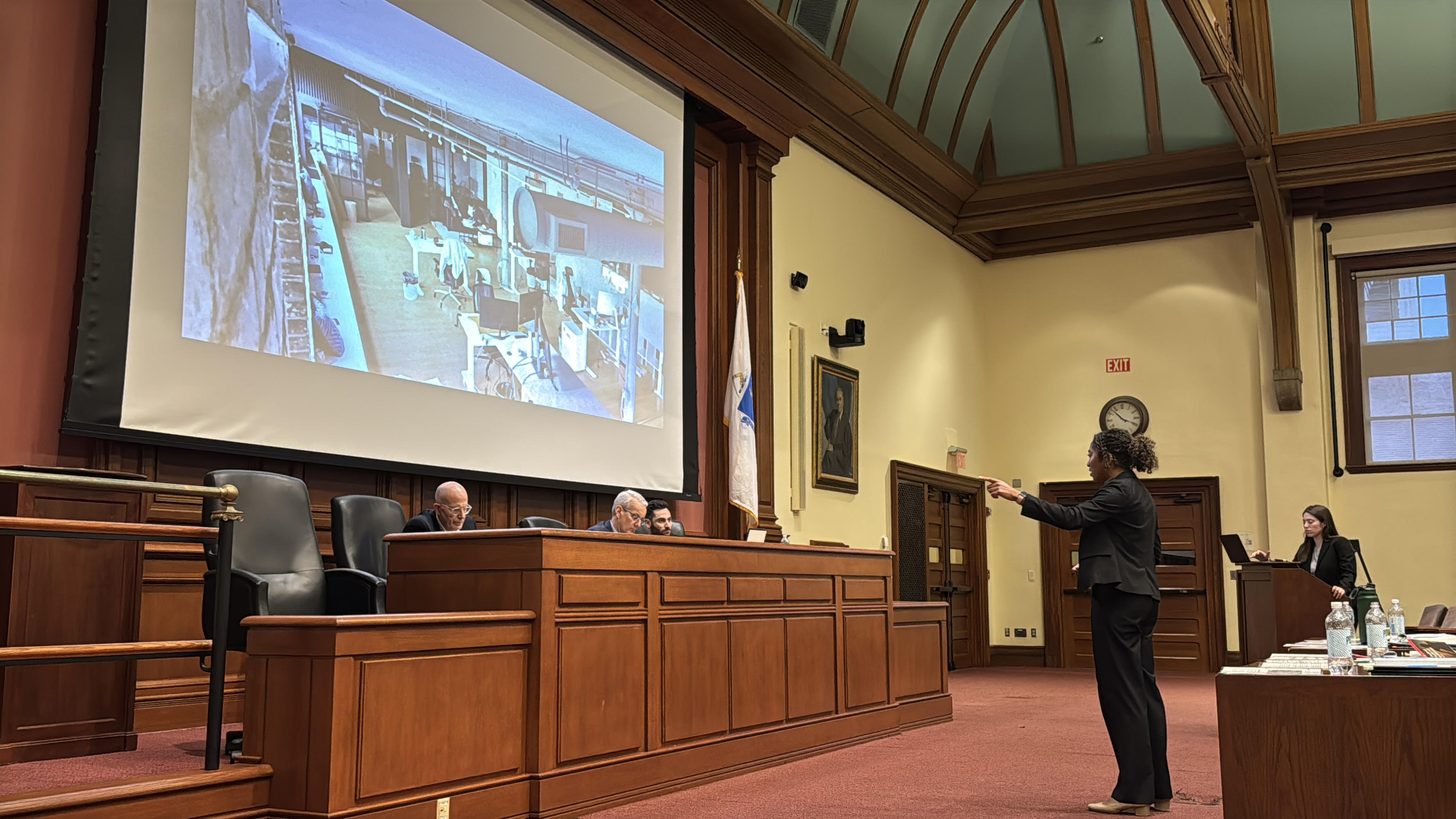
The civil case at issue at the competition (Yasinovsky v. Light Cloud, Inc.) was all about the line between the real and unreal. What separated the positions of the supposed whistle-blower plaintiff and the AI company that fired him was a video of a supposed break-in by the plaintiff into the company’s office. But was that video real, or a convincing fake created by the company’s CEO, who was an AI genius?
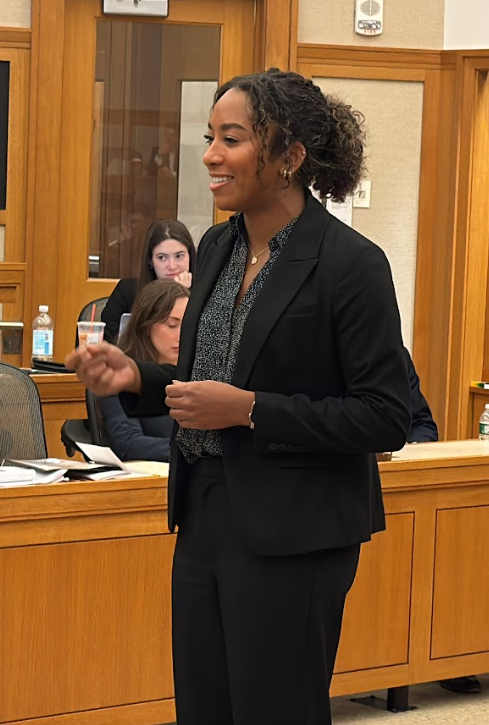
Round after round, over the course of three days, our team (Hannah Phillips ’27, Melanie Sztulman ’26, and Sarah Kaplan ’26) switched between the plaintiff and defense side. Hannah advocated on both sides of the case in her first-ever competition as a representative of our school and took home a best advocate award (a gavel), for having received among the highest scores of all of the students at the competition.
When they weren’t serving as attorneys, Melanie and Sarah played their side’s expert witness, memorizing the details of metadata and motion vector analysis, and the factors that called into question the authenticity of the video (including frame irregularities, lighting and shadow variations, visual warping and edge artifacts, and the absence of device specific residue). Drawing on many hours of preparation over Zoom and on their feet in Stuart 401 in the weeks leading up to the competition, the team’s creativity and competence shone. Two moments in particular come to mind. The first is the insuppressible smile that crept over Melanie’s face as she wrote out on the blackboard, in giant font, the giant sum the opposing expert would be paid in the event of a win for her side ($ 2 5 0, 0 0 0). Then, in closing, she pulled that blackboard down with a reverberating thud that underlined the quarter million reasons she told the jury that the expert had to lie.
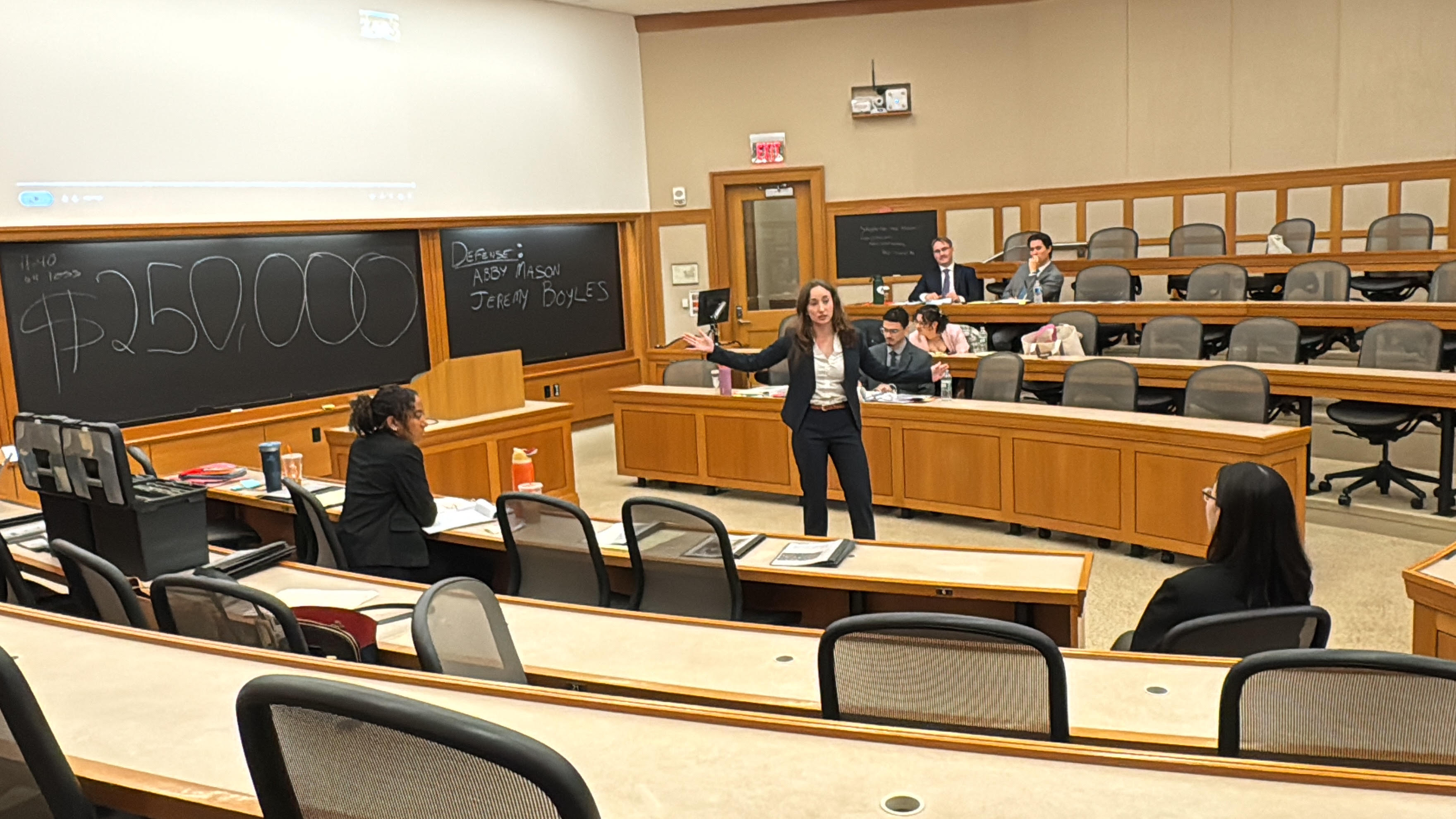
The second involved the extraordinary command that Sarah displayed testifying as the plaintiff expert. Dodging every line of attack, she insisted on seeing the time stamps on the moments in the video being played to her, and clarified at every juncture how the abnormalities in the video were graver than her cross-examiner wanted to acknowledge.
Though they were likely running on fumes entering their fifth trial in three days, the team gave its best performance in the final round, which was held under the majestic vaulted ceiling of Harvard’s Ames courtroom. Representing the defense, Sarah’s opening commanded the palatial room, bringing it to full silence as she explained how the plaintiff’s resentment of his best friend’s star-role at the company clouded his judgment and bent his view of reality. Hannah’s searing cross of the plaintiff had him admitting that he was filled with vengeance. Sarah impeached the opposing expert on the methods she used in coming to her conclusions. Then Melanie, now on the defense side, deflated the importance of her contingent fee with an elegant form of casualness, demonstrating to the jury through her words and demeanor that it was perfectly natural that she was given $250,000 for her services. Finally, Hannah brought it all together masterfully in closing, using the video of the break-in to highlight the unreasonableness of the plaintiff’s position.

The result was unanimous, both in votes for best advocate in the final round (Sarah Kaplan) and the winner: Boston College Law School.
We would like to thank the Harvard Law School Mock Trial Association for including us in the group of talented programs from across New England, and beyond, that were invited to this competition. They were very generous hosts. This was the inaugural year for the competition, and it was a tremendous accomplishment for them to create an excellent one, complete with an interesting case problem, great judges and great witnesses. And finally, a huge note of thanks and congratulations once again for the students, who worked so tirelessly and brought it home when the big moment came!
For more on this fall’s winning advocacy teams, see this BC Law Magazine story.
Steven Van Dyke is an assistant clinical professor and the director of BC Law’s Defenders Clinic. He is also one of the coaches for BC Law’s Mock Trial team, along with Julie Buszuwski.
 BC Law: Impact
Pingback: Advocacy Teams Excel in Fall Competitions – Boston College Law School Magazine