Today’s guest post is written by Glenn Cunha, a Boston College graduate, BC Law adjunct professor, a former managing attorney of the Criminal Bureau in the Massachusetts Attorney General’s Office and retired Massachusetts Inspector General. He is currently serving as a special prosecutor to the Suffolk County District Attorney.
Please note that today’s post contains language and situations that may be upsetting.
As lawyers, we sometimes take for granted the skills we have honed over the years during law school and in practice. I wanted to become a lawyer when I realized I could have a career based on talking, arguing and going after bullies. It’s just who I am. Teachers, family members, coaches and friends would always tell me that I would make a good lawyer someday.
The legal skills we use — advocacy, quick thinking, level headedness — are skills I’ve had my whole life. I certainly refined them as a law student and throughout my career but because they are so natural to me, I tend to think everyone has them. After a situation this past summer, it became apparent to me that this isn’t necessarily true.
A friend and I were playing tennis in Provincetown at the public courts. Two of the three tennis courts also have pickleball lines painted on them. We started playing at 8am, and after about 20 minutes, a group of six men and two women showed up to play pickleball. After they started to become disruptive to our own game, my friend pointed out a sign to me which clearly designated certain times for tennis and pickleball throughout the day. Before taking any action, I looked at the sign (quite large and professionally made, not marker on a poster board), which clearly stated the hours for tennis were 8am – 1pm and pickleball were 1-5 pm. It also listed contact information for the town Recreation Department.
I walked over and spoke to the man closest to us. In my calmest, non-confrontational voice, I told him about the sign that posted the hours for these courts and about some new pickleball courts nearby they could use. He held up his pickleball paddle in front of my face. “We are not leaving, we have been playing here for two weeks and no one has said anything until you,” he said.
Another person yelled, “Are we bothering you?”
“The sound of the pickleball is distracting, and pickleball starts at 1,” I said.
His response was, “So your faggot ears can’t handle the sound.”
I turned around, went to the sign and got the phone number for the Rec department. I left a voice message and then sent an email to the address listed. As my friend and I continued to play tennis, they continued to play pickleball and harass us by saying things like, “Hey Jimmy, was that too loud for you?”
About fifteen minutes later a person from the Rec Department arrived and told them to leave. They resisted. “You’re going to let these faggots stay?” the first man said. He was furious.
The Rec Department employee didn’t say much more, but was eventually successful at getting them to leave. As he was moving them toward the gate like he was herding cats, the parting shot came from the ring leader of their group. It was directed at my friend, who is dark skinned and emigrated to the US as a teenager from Southeast Asia. “Why don’t you go back where you came from!”
My friend is a Harvard-educated medical doctor, and a very accomplished person. But although it clearly upset him greatly, he just didn’t know how to deal with this situation. He did stay on the court with me as this all happened, but didn’t respond or react to the man who made this statement.
After the group was escorted off the courts, we continued with our tennis match for a while, and we didn’t talk about what had happened until we finished playing. When I asked him how he was doing, he said he didn’t feel well and just wanted to go back to his place. He was clearly still shaken and upset.
I shared with him that I hadn’t been called a faggot in fifteen years. But this hadn’t been the first time either. Around 2008, my boss and I had disagreed about how to handle a case. “Don’t be a such a faggot,” he said to me. He knew I was gay. I initially gave him the benefit of the doubt, thinking maybe he didn’t realize the impact of the word. Maybe he was using the word as a pejorative, like calling someone a “jerk” or an “idiot.” I didn’t confront him then, but as time went on, I got more and more angry about it. I thought about the consequences that could happen if I confronted him, told him I was offended or even went to HR — none seemed to end in my favor. At that time, I had two young children, a mortgage and a growing career. The costs outweighed the benefits of speaking up for myself. I couldn’t take such a risk.
The context of the situation on the tennis court was different, but the impact was similar. When I shared this story about my boss with my friend, my voice cracked as I choked up. Over the years since that happened, I had told people the story before without such an emotional reaction. But those feelings of shame resurfaced with this incident. It felt good to talk to my friend about what had happened to me, but he wasn’t ready to talk about how this incident on the tennis court had affected him.
A couple of weeks after the incident, my friend told me he’d been having a hard time dealing with everything that happened that day. He felt like he had done nothing to back me up and — worse — he felt like he didn’t stand up for himself. Though he is a very intelligent and accomplished individual, he hadn’t learned how to handle confrontation, or the emotions that come with situations like that.
As a prosecutor for 20 years and a lawyer for 30, I have spent a lot of time working with crime victims. I understood how he felt and I did my best to acknowledge the pain and shame he was feeling. In my message to my friend, I used similar language that I have learned to use to help victims throughout my career. It’s important that they understand that they were not at fault for what happened to them, or for what they didn’t do in the moment.
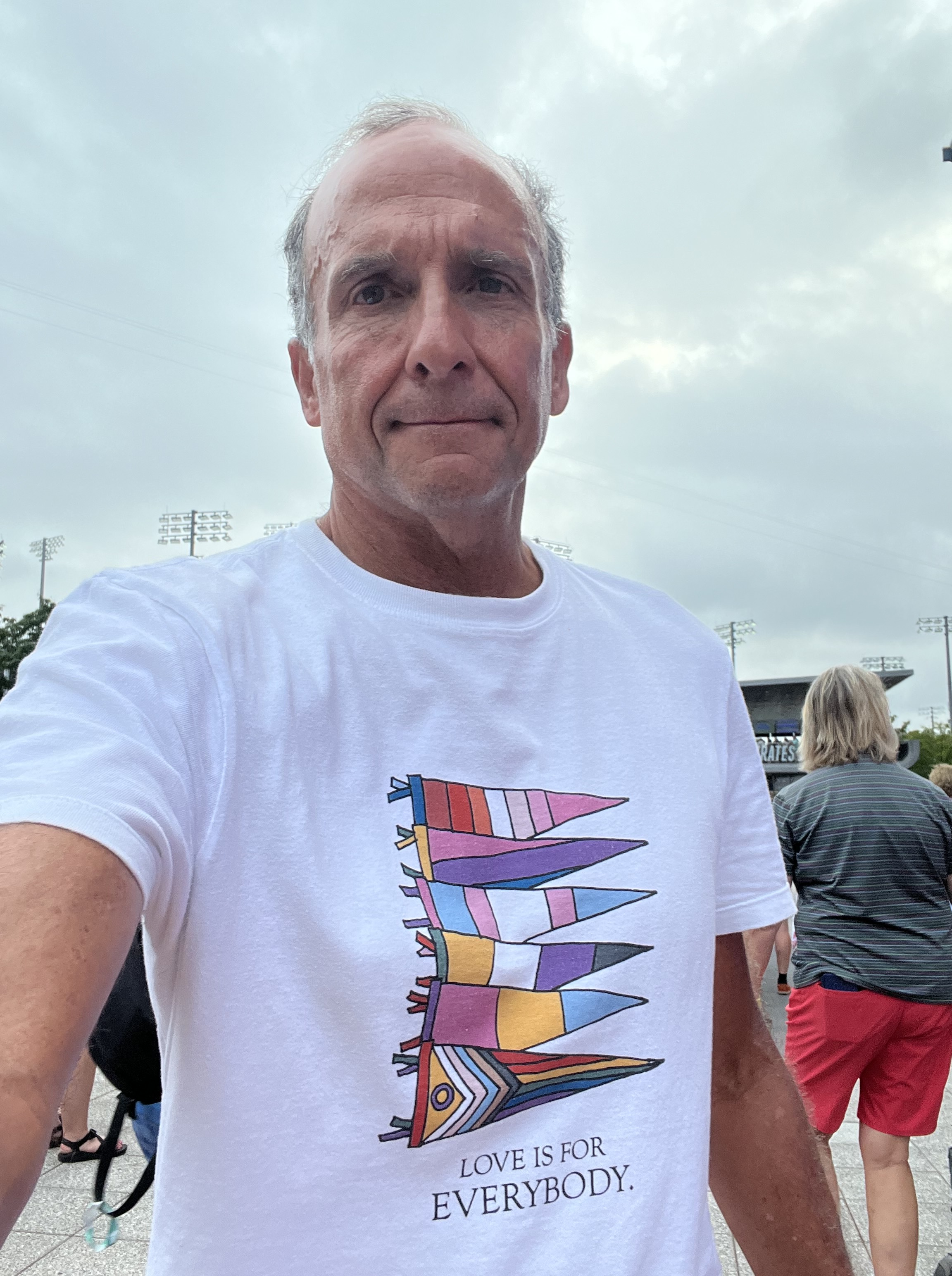
After this happened I thought more about what my boss had said to me, years ago. I thought about taking action. I started wearing a t-shirt I had not yet worn, which has the different flags used by the LGBTQIA community and has “Love is for Everybody” written on it. I wore it to the US Open this year as a badge of honor. It felt empowering, especially when people came up to me and told me, “I love your shirt.” I sent my friend a photo from Flushing, Queens of me wearing the shirt. He responded that he loved it, so I sent him one along with a note to wear it to ward off the bullies. I hoped the shirt would help give him a similar feeling of empowerment.
My friend and I handled a difficult situation very differently. I think I handled it like a lawyer: I identified the issue and made my case to the other party. When that didn’t work, I got help from someone with authority to act. I was able to handle the situation without it taking a violent turn.
As lawyers, we have to learn all the rules — criminal and civil procedure, case law, administrative law to name a few — but we also rely on our guts and instincts. We read the room. In 2008, when my boss called me a faggot, I was at a very different place in my life and my career. I decided that the potential consequences of action were too great. Maybe I was wrong, or maybe I was right, but I used my legal reasoning skills to come to that conclusion at the time. At that time in my life, however, I am also pretty certain I would not have written an essay like this for publication, hoping to have an impact on someone who might be in a similar situation. Things are different now.
While speaking up, defending ourselves and others may seem like second nature to us, it likely doesn’t feel as natural for other types of professionals. For non lawyers, situations like the ones I have highlighted may be overwhelming and they may not be as comfortable or familiar with handling confrontation.
That is when they need to hire a lawyer.
 BC Law: Impact