This summer, I binge watched eight seasons of “Suits.”
I’m in company alongside millions of others who tallied over 12.8 billion minutes of streaming the Big Law drama across Netflix and Peacock. “Suits” earned a record-breaking second-life this past summer, becoming the most-watched acquired title in Nielson history from June 26 to July 2. It also became the first show to amass over 3 billion minutes watched for seven straight weeks.
It’s slightly sadistic for me to obsess over “Suits” after clocking in hours as a summer associate. But perhaps what’s worse is drawing analogies between “Suits” episodes and Moral Professional Responsibility hypotheticals.
I’m currently enrolled in a version of the ABA-required course taught by Professor Mike Cassidy. It’s a three-credit course compared to the typical two-credit version. A course in Professional Responsibility is required for all students attending an ABA-accredited law school. The class prepares students to take the Professional Responsibility exam and introduces them to many rules regulating and obligating lawyers.
I’m only four and a half weeks into the class, but I can readily account the many times Harvey Specter, Jessica Pearson, Mike Ross, and Louis Litt broke ABA rules throughout their adventures.
1.2(a) A lawyer shall abide by a client’s decision concerning the objectives of representation, and as required by Rule 1.4, shall consult with the client as to the means which they are to be pursued.
Lawyers decide the means of representation, but clients determine the objective of it. This means that lawyers can dictate litigation or negotiation strategies but cannot alter a client’s legal goal. Thus, if a client expressly desires a settlement, a lawyer cannot push a case to trial. If a client wants to plead testify, a lawyer must add them to the witness list.
Harvey potentially violated this while representing McKernan Motors. The car company’s new CEO, Robert Stensland, informs Harvey that he wants to outsource manufacturing to a foreign country. Harvey disagrees with this business strategy and starts experimenting with the company’s bylaws to oust Stensland.
Even if Harvey may disagree with Stensland’s decision, that’s not his call. It’s Stensland’s business judgment — it’s McKernan Motors’ business judgment. According to rule 1.13, when constituents of an organization make decisions about it, a lawyer must accept such decisions even if their utility is doubtful.
The objective of McKernan Motors’ representation was to expand business operations overseas, not change their board of directors.

1.2(d) A lawyer shall not counsel a client to engage, or assist a client, in conduct that the lawyer knows is criminal or fraudulent
In other words, don’t help anyone do anything illegal. But this happened more than once on the show.
Here’s one example: Harvard ethics Professor Henry Gerard accepts a $25,000 check in exchange for changing his student’s grade. To prevent Professor Gerard from being exposed, Mike has his student sign an affidavit stating that the money was issued for a loan. At this time, Professor Gerard is a client of Harvey’s — and subsequently, a client of Mike’s.

8.3 and Formal Opinion 94-383 A lawyer shall not present, participate in presenting, or threaten to present criminal charges solely to obtain an advantage in a civil matter
Lawyers can threaten sanctions or criminal complaints related to civil cases, but the ABA restricts holding unrelated criminal or disciplinary charges over opposing counsel as leverage in a civil matter. While the ABA does not expressly prohibit lawyers from presenting criminal charges against opposing counsel, it does not allow lawyers to utilize threats regarding misconduct that raises a substantial question about opposing counsel’s honesty, trustworthiness, or fitness as a lawyer. Such threats violate the ABA Rules because a lawyer is ethically required to report such misconduct regarding opposing counsel.
Thus, James Quelling committed this bar violation when he threatened Harvey to report Mike to the bar for a conspired settlement. (During the Hessington Oil case, Mike approached Harold to file lawsuits on behalf of the witnesses in the case and agree to a settlement).
And obviously, Jessica, Louis, Harvey — pretty much everyone who stepped foot into Pearson Specter who knew about Mike’s fraudulent representation — were obligated to report it to the bar.

Reciprocal discipline
Reciprocal discipline is the imposition of a disciplinary sanction on a lawyer who has been disciplined in another jurisdiction. Many jurisdictions adopt reciprocal discipline into their Rules of Conduct, and the ABA also promotes it in their Model Rules. According to the Comment for ABA Rule 8.5, “it is longstanding law that the conduct of a lawyer admitted to practice in this jurisdiction is subject to the disciplinary authority of this jurisdiction.” The ABA notes that practicing reciprocal discipline protects citizens in each respective jurisdiction.
Thus, Jessica was incorrect when she said that “no one in Chicago would care” about her New York disbarment. Deputy Attorney General Andrew Malik filed a motion to disbar Jessica for knowingly employing a fraudulent attorney as revenge for losing a case against Harvey.
The Chicago Bar would most definitely take note of Jessica’s disbarment, especially as the reasons for it affect Jessica’s honesty, trustworthiness, and fitness as a lawyer.
Most people realize that the shady tactics employed throughout Suits (wiretapping, impersonation, even physical violence to name a few) are not permitted in ethical legal practice.
But, toeing the line between doing what is “right,” whether that be for yourself and for your client, is not the moral qualm the Suits lawyers make it out to be.
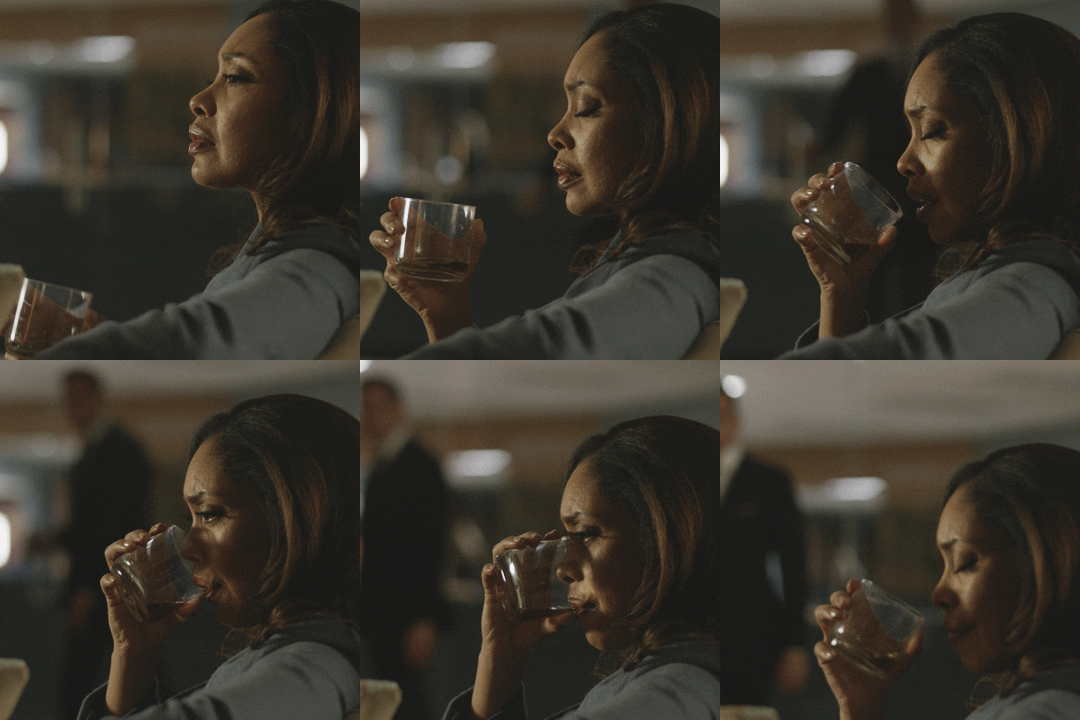
For starters, maybe don’t hire a fraudulent attorney. Don’t lie, don’t steal, and don’t cheat. The rest should come easily.
Kristie-Valerie Hoang is a second-year student at BC Law. Contact her at hoangkr@bc.edu.
 BC Law: Impact